Showing posts with label birds. Show all posts

Tuesday, October 28, 2014

Tasks

One of the most persistent misconceptions about vineyard work is that most of it takes place in summer.

Entirely understandable, since grapes, with their luxurious green leaves and delectable sweet fruits, seem the very essence of summer.

But truth be told, in the fall, winter, and spring, a LOT of behind the scenes work goes on.

Most of the summer, we are highly visible in the vine rows, attempting to wrestle rampant vine growth onto an orderly trellis.

In all the other months, our work is more varied.

One small task after the harvest, all of our row netting needs to be removed from the trellis and stored.

To expedite the process this year, I devised this contraption:


Like many of the world's great inventions, it started as pallets, scrap lumber and threaded pipe.

Five acres of bird netting, now spooled, neatly stacked, and stored.


What's on board for November?

Record keeping, trellis repair, equipment maintenance and inventory, weed control.

In December, we'll prune the orchard, and in the vineyard, prune and weigh canes from a random sample of vineyard vines across all six vineyard blocks, to assess this past season's growth, and plan dormant season pruning, which begins mid-January in earnest.

Friday, June 6, 2014

Bloom

Newly emerged Marquette leaves, weighted by dew at sunrise.

These abundant June mornings, we arrive at sunrise to a vineyard dripping with dew, and noisy with new life.

The vineyard is in bloom. 

On our historic farm property, this moment in the life of the vines coincides with a time when our diverse 55 acres of woodland, pasture, vineyard, orchard, and still &  flowing water greets us each day with new blossoms, freshly unfurled foliage, and, everywhere, creatures newly born and hatched.

I've never read a poetic ode to the glory of a vineyard in bloom.

The grape flowers themselves are green or a dull sulfurous yellow: exquisite in their own minuscule  perfection, but hardly showy enough to inspire a wandering bard to commit the sight to verse.

Inconspicuous Marquette bloom.
But let me attempt to paint a word picture of what a day in our vineyard looks like, in this short hopeful season when the grape vines bloom:

Our vineyard office sits atop a small swell of land, providing an opportune vantage to start our day. (I imagine the pioneer farmer who chose this site for his house had this exact morning vista in mind.)

We see the South Vineyard unfurling on a distant sunny slope.

In the foreground, steam rises from the spring-fed mill pond.

Our resident Great Blue Heron stands in majestic stillness on the barn stone shore line. Upon our approach, she silently swoops off with effortless grace.

A box turtle has slowly and methodically made her way from the distant lake to a bare patch of earth, where she deposits her eggs.

She blinks at us with startlingly pretty red-framed eyes.


Walking past the historic barn of virgin Ohio oak, we come upon the North Vineyard, and as we do so, Betty the brown duck toddles out from her nest under the hydrangeas, where she tends a clutch of eight eggs.

Arriving in the Marquette block of the vineyard, the sections we've worked through this week display neat walls of bright green foliage, contained between strands of galvanized wire.

Each of those thousands of rampant shoots was hand trained vertically to create this transitory scene of perfect order.

In a few more days, those newly trained rows, fed by abundant rain, lengthening days, and fertile loam, will produce another round of prodigious new growth, and we will start over once again from where we so recently began: restoring our version of Eden on what would prefer to be wilderness.

We walk down the rows, tucking some errant shoots that were either missed yesterday, or that grew overnight and flopped to the ground under the weight of a heavy morning dew.

Grape leaves that weeks ago were perhaps the size of a silver dollar are now bigger than my outstretched hand.


We scout for pests, mildew, mold, blight.

We check the rain gauge and the vineyard weather station.

Now, we enter the last rows of Marquette vines, the ones we have yet to tend in this round of training.

We are no longer in Eden, but somewhere far more primal. 

Thick blood-red shoots sprout from the base of the vines, and from all along the woody gnarled trunks. They seem to reach and grasp, bright red tendrils straining (menacingly?) for something to latch onto.

New green leaves unfurl above the trellis, dripping with dew, illuminated by the rising sun. 

We don't pause for too long, not for fear of the tendrils, but because this sunrise survey is just a short part of the work of our day.

Before moving along, however, we notice how incredibly LOUD the life in the vines can be in this season of bloom.

Killdeer hatched a few weeks ago when the grape buds first burst now scurry beneath the vineyard rows, trilling, singing, fanning their tails. 

On the lake shore, water fowl noisily squawk ancient rivalries, defending terrain, protecting their broods.

On the row ends, our newly-mounted bluebird houses are fully occupied.

A shiny indigo-breasted swallow emerges from one, splitting her attention between two ardent rivals.

Full Occupancy
Even the locust vineyard poles that support the galvanized wire and rampant vines sing: from knot hole nests within, the cheeping and chirping of newly hatched swallows.

Singing locust poles.
And so the work of the day commences.

This day when the vines blossom with insignificant flower, we hope to complete this section of Marquette, and make progress through the more orderly Frontenac Gris just beyond.

At the end of the day, we will pause at the end of our newly ordered rows, as errant red shoots we removed from craggy trunks shrivel on lush vineyard turf under a pleasant June sun.

We will pause for a moment, relishing the symmetry and order we have just imposed.

We will feel pride in the work accomplished in this bountiful June day.

And we will feel humbled, knowing that by Monday, it will be time to start over and do it all again.

Caught up in the new life unfolding so abundantly around us, we keep the perspective that it won't always be this way.

This season of bloom is the lush peak of the vineyard's yearly cycle.

Soon, the Solstice.

The days will imperceptibly shorten.

New growth will ebb ever so slightly.

Grape vines will put their energy into converting those insignificant dull blossoms into vibrant, sweet fruit.

Until then, we just try to keep up with the rampant vines, and enjoy the view along the way.

Fleeting perfection of order imposed.


Thursday, April 24, 2014

Swell

The flowers are come on the earth; 
the time of cutting the vines is come, 
and the voice of the dove is sounding in our land.
~Song of Songs 2:12


It's a time of pregnant expectation in the vineyard.

A pair of elegant mourning doves has produced the first brood of the vineyard season, and all around us, expectant ducks and robins and killdeer and blue birds flit about building and tending nests.

Amidst the vines, it's positively raucous at sunrise, even on mornings when frost paints the daffodils.

But our vineyard birds aren't the only ones anxious and expectant these long awaited first warm days of the season. Those of us who tend the vines are also carefully monitoring our "babies" (4,178 of them to be exact.)

Since the first vortex we've been carefully monitoring the buds on thousands of individual vines.

Each new plunge of the thermometer sends us crunching through insulating snow to gather representative sample canes from six grape varieties, in eight vineyard blocks, spread across almost six acres.


Our historic farmhouse, April 15, 2014
We bring them into the warmth of our vineyard office, adjoining the circa 1830 farmhouse on our historic farm,  to thaw out. We then patiently slice each compound bud open with a razor blade under a magnifying lens, to examine the primary, secondary and tertiary buds contained within.

One hundred compound buds sampled, from each of the eight vineyard blocks. We do this each time the temperature plunges. (I'm an English major, not a mathematician, so I will let someone else do the math as to how many buds we looked at over the course of this frigid winter.)

So lets just say, ballpark, scads of buds examined.

And we are reasonably confident that our hardiest Minnesota hybrids came through with a 97% bud survival rate. In a winter of dismal vineyard news from across the Midwest, a glimmer of hope from our young vineyard in Canton. (Although anything can yet happen, and any grape farmer would be foolish to predict a crop in our climate until at least June.)

So, we are not out of the woods yet.

A week ago, the morning of the Full Blood Moon, we arrive to find the old farm under yet another blanket of snow. Overnight vineyard temperatures were logged at 19 degrees, at a time when the grape buds had already started to swell.

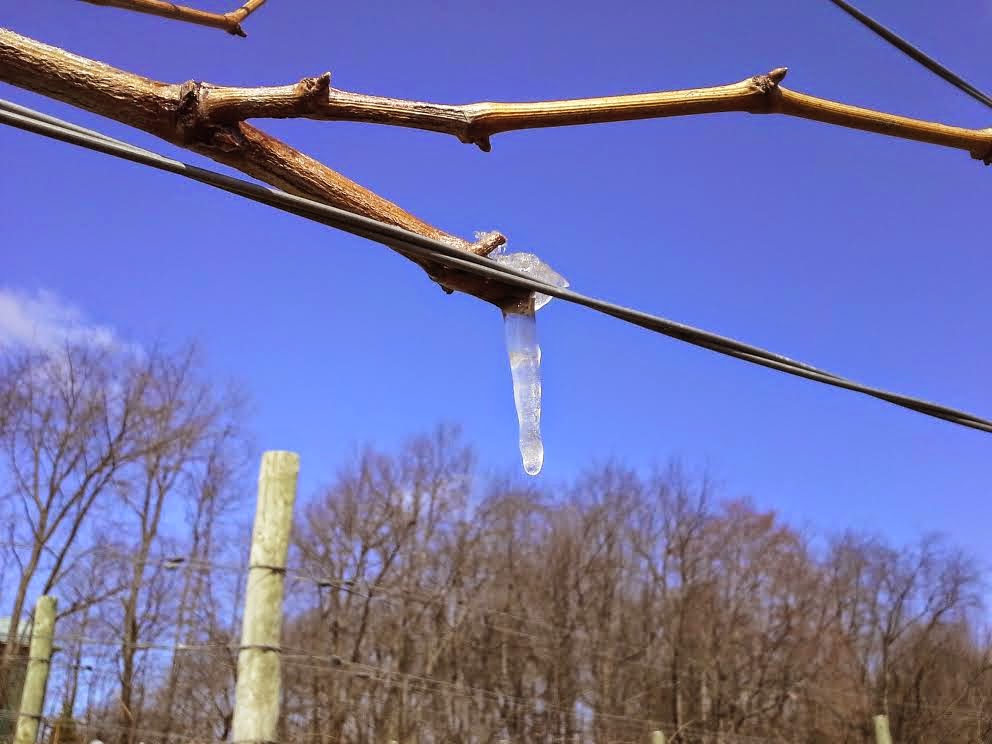
So out we go once more to sample, this time gathering canes from vines dripping with "sap sicles."

"Sap sicle" from a pruning cut in the South Vineyard, April 15, 2015

A week after the blood moon, the buds are still alive, and continuing to swell. Any moment now, we will begin to see the pink and green foliage emerge from the earliest buds to break.

Grape vines exhibit apical dominance, which means the highest buds on each plant break dormancy first, and leaf out before the others.

For this reason, in our micro-climate, which is subject to heartbreaking late spring freezes, we leave longer spurs than are necessary on each plant when we do our winter pruning.

If anxious grape plants decide to break dormancy before winter decides it is ready to release us from its frosty talon, apical dominance ensures that we will have reserve buds lower on the plant to produce a crop.

This strategy of double pruning also means double the pruning labor, but is a necessary provision in our viticultural region.

A carafe of grape canes, forced to break bud.

A few weeks ago, as one dismal report after another rolled in from vineyards throughout the Eastern U.S., I stuck a few pruned grape canes in a wine carafe of water. We'd examined the buds multiple times, tabulating the number of kiwi-green live buds we encountered on each sample cane.

We knew the buds were alive. But still, just to be sure, we couldn't relax until we saw leaves emerge.

And so the other day, that hot house vase of grape canes broke bud.

Pink and green leaflets emerged first.

Then fully fledged leaves.

Now, a few days later, long green shoots, each with several leaves, emerging from the top bud on each cane, as apical dominance decrees.

Any day now, we hope to see the same thing happen on our vineyard vines.

And just like Betty the brown duck, who nests under our hydrangea bushes each year, as soon as our babies hatch, we will puff ourselves up a little bit and show them off.

Betty shows off here on our spring-fed lake, displaying her handsome brood in a neat row on the v-shaped wake she forms through sun-warmed water.

We in the vineyard will show off our equally handsome brood here on the interwebs. Any day now, once the buds break. Stay tuned...

(And we promise, this will be the last of the icy vineyard posts! I think we also said that in February. But this time, we really, really, mean it!)

UPDATE April 28th: 
One of the interesting things about growing grapes, is how localized conditions and micro climates can affect a particular vineyard. Interesting story in our hometown newspaper today about how the same conditions have had different effects at some of our neighboring vineyards:


Thursday, April 10, 2014

Quickening

Suddenly, with a flip of the calendar page, everything has changed amongst the birds.

Winter was a time to hunker down. 


Enormous flocks of Canada geese wintered with us, slumbering en masse at night on the iced lake, by day grubbing voraciously through a mantle of snow to pluck victuals from the turf. In their wake, a cacophony of churned earth and webbed foot prints.

Of a January vineyard morning, I would crunch through diamond-crusted snow before sunrise. 

At sunrise, coming to a small patch of open water, and the flotilla of ice where our swans slumber, I would feel like I'd entered a secret avian dream world: All is peace and crystalline beauty

The swans allowed a small trusted bevy of geese to sleep amongst them on their floating bed chamber, the rest banished to the lakeshore with the ducks. How very wise, I thought, to have these squawky sentries close at hand during the vulnerable silent hours.

During those peaceful winter mornings, I would observe that our ducks never sleep on the ice, except when there is a downy blanket of snow. On a snowy January morning, I arrived at sunrise to find our entire duck colony asleep on snowy ice. They rose with the sun, and begin chattering amongst themselves, waddling busily on the ice. (I think I could be content to watch ducks walk on ice all day.)

But change is afoot in the vineyard, the quickening of the year. 


Maple buds swelling against an April sky.

Skunk cabbage shoots rise steamily from the creekbed. 

Gliding raptors, aloft in a sky that is suddenly cerulean, dangle entrails of branches. 

On a rainy morning I notice our pair of mute swans display a newfound interest in golden willow branches that litter the lawn.

These quickening days, and an ever changing sky:

To the South, golden rays, impossible blue skies, fluffy white clouds.

Northward, impending wintry nebula, dark and foreboding. 

On many days snow flurries mixed with drizzle and warmth. 

This fleeting season, marked by the mysterious arrival of impossibly vivid ducks, with crimson necks. 

Raw, windswept March has just passed, when you would experience all of the seasons in just one day.

But gone now is March, and with it, the mysterious crimson ducks that visit each winter, then disappear as quickly as the whiteout flurries that sometimes materialized to displace a mid-afternoon sun.

The day the crimson ducks departed marked a noticeable change in avian behavior. 

All winter everyone got along, but the day the ducks left, our territorial male swan was suddenly bound and determined to keep a pair of Canada geese from nesting under a cherry tree. I could swear they are the exact same pair that tried to nest here last year, under a pine tree that is now gone. 

As the days lengthen, gone are the large colonies of ducks who gobbled at the swan chow bowl on frigid winter days.

Gone the riotous gaggle of geese who slumbered on the ice by night and rooted riotously through vineyard rows for daytime grub.

Gone the marauding robins who came out of nowhere to strip to bare twigs a crabapple tree which had somehow held its fruit through Christmas.

On these suddenly sunny April days, the birds have all paired off:

The swans daub a nest from mud and leaves and willow branches in a swampy finger of the lake.

An iridescent mallard and his handsome brown speckled bride toddle about the shrubbery at sunrise, looking for a place where in a few weeks she may deposit her eggs.

A pair of elegant mourning doves coo beside an old grape press in the rose bushes, seemingly grateful for the now bare earth on which to roost.

There is something to be said for days spent tending a vineyard. 

Even days that sometimes start with pelting sleet and a glaze of ice. 

And especially days during this magic season, when the year quickens perceptibly, and avian behavior takes a marked seasonal turn. 

An entire complex avian world goes about its seasons on the shore of this lake, and we feel privileged to be here to watch it unfold.

And throughout it all, in every season, a solitary Great Blue Heron swoops overhead, knowingly. (And sometimes, I kind of get the feeling that heron is orchestrating the whole thing.)


Skunk cabbage steamily rises.

Friday, December 13, 2013

Clarity


One of the remarkable things about tending these acres in all season and conditions, is getting to experience the subtleties of each season.

We often perceive winter in Northeastern Ohio as an undifferentiated blur of salt-stained gray.

But a shift in the clouds, however fleeting, can reveal startling colors and clarity, especially on a single digit December afternoon, when ice crusted snow sparkles beneath a startling clear blue sky, and the competing textures of flowing water and solid ice create a stunning backdrop for our avian vineyard friends.