Showing posts with label senescence. Show all posts

Friday, October 30, 2015

Blaze

Autumn’s glory descends on our corner of Stark County, Ohio.


In our neighboring crossroads cemetery, a weathered limestone maiden, missing an arm, maintains her perch atop a stone pedestal. She surveys the blaze of sugar maples, late but resplendent in their color this year.
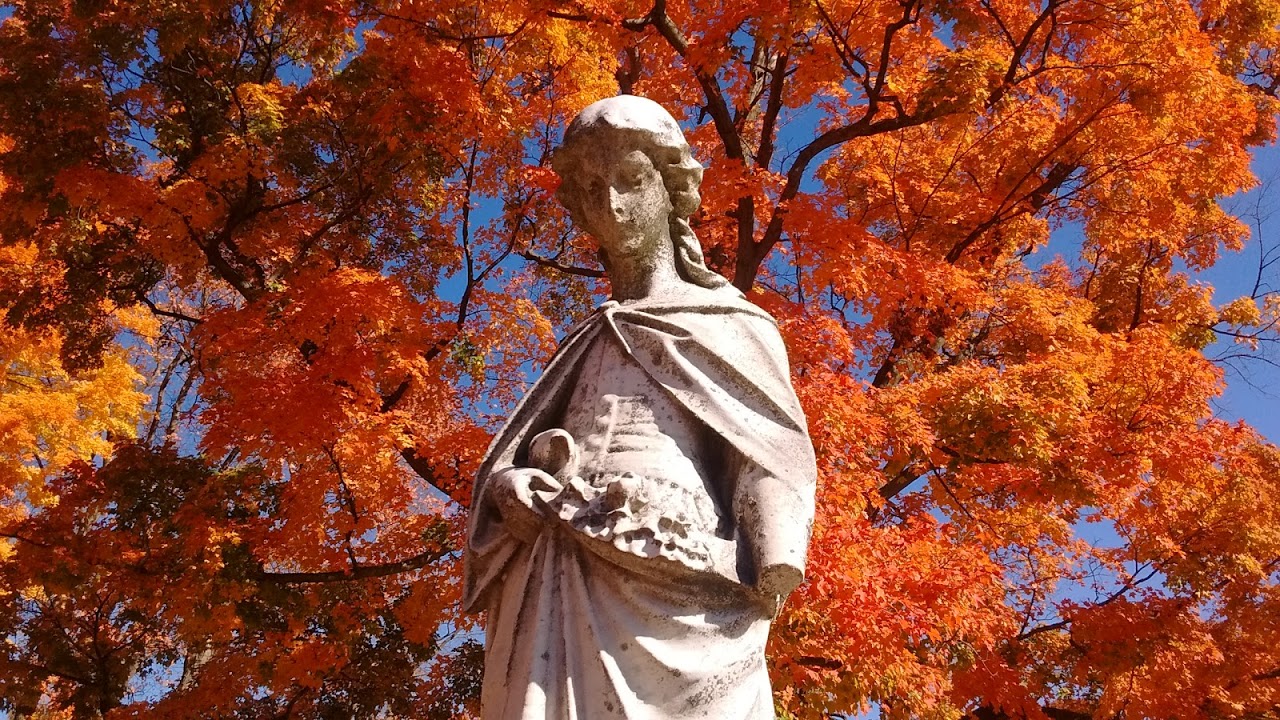

In just a few days, the shortening days and lengthening rays of autumn light have drastically changed the colors in the scenery all around her. Her stone countenance, impassive, takes it all in.

Having surveyed this crossroads plot of gravestones and maple trees for decades, I imagine our stony maiden has gained enough wisdom to avoid declaring this year’s fall color better than that of any other.

October 5, 2015: Aromella vines in the South Vineyard begin to display their varietal fall color.
I have only tended the vines in the neighboring vineyard for half a decade.

But in those years of watching the seasons unfurl and then retract, I have absorbed the deep seasonal rhythms of this fixed spot on the globe. I have learned that no one season is like any other, and comparisons between them are hard to make.

Through every season, we observe and record sequences:

October 15, 2015: sweetgum branch against marsh reeds
In the spring, we anxiously record for our phenology log when the wild plants on our farm break bud and then set flower. The first to emerge, melting a hole through the snow covering them, are the skunk cabbages, arising steamily in the marsh with an aroma of carrion to entice flies and wasps, the season’s first pollinators.

October 19, 2015: late ripening apples in the orchard
Months later come the apple blossoms, wafting a sweet scent across the orchard to attract the honeybees.

Although the sequence remains largely the same, the calendar dates of when plants choose to leaf out and then blossom varies from year to year, as does the exact overlap of when various species are in simultaneous bloom.

In a year when many things bloom together in a flowery riot, it is easy to declare that it is the best spring ever.

But then comes a season when blossoms are more evenly spaced, the season’s flowering more staggered. The staggered season is perfect in its own way: a chance for us to appreciate each flower, a chance for the honey bees to enjoy a more consistent diet of varied nectar.

Once summer arrives in the vineyard, it is the rainfall and accumulation of growing degree days that we observe and record.

Newly furrowed vineyard rows in North Vineyard, couched by October frost.

The flavor of the grapes we harvest are a record of the heat and relative wetness of the summer that ripened them.

In our minds, there is always a perfect ideal for the balance of sweetness, acidity, and juiciness that we hope the ripe fruit will attain.

Frontenac Gris block, North Vineyard: early leaf fall this year.
But no growing season is like any other.

The humans who tend the vines can do some things to subtly affect ripening: we can pull more or fewer leaves from the green buckshot berries to encourage and speed ripening, we can limit the size of the crop to condense the plant’s energies into fewer, more flavorful clusters.

But what happens on the vines is largely a product of the season, and the effect of our human efforts, subtle.

Like the stone-faced cemetery maiden, we learn to regard each season, and each vintage, as its own perfection: it is what the earth yielded.

We may prefer an autumn when the Virginia creeper, the sweetgums, and the sassafras all blaze together.

But some years the season chooses to color each one on its own schedule.

Sassafras foliage along North Vineyard, dispalying varietal leaf shape variation.

And so in the vineyard, in the last days of October, we find ourselves in the season of senescence, when this summer’s green and rampant shoots finish hardening and maturing into next season’s fruiting canes.

South Vineyard, October 24, 2015

Last year, the grapevines luxuriated in a lazy, lengthy cane ripening season: our vineyard was striped with each variety achieving its fall color in its own sweet time, the leaves fully maturing, then falling to the ground.

Frosty vineyard roses, October 20, 2015

This season’s foliage color and cane ripening was more condensed: a hard frost on the morning of October 20th kissed the vineyard roses, and before the afternoon was over, green and golden grape leaves that were frost crusted at sunrise were brittle and brown, hastening the dormancy of the canes, signaling the end of the growing season.

October 20, 2015: Morning sun melts frosted grape foliage. By afternoon, the leaves will shrivel and shed.

As perennial woody plants, our vines accumulate the events of each season. Next year’s vintage will be a record of not one season, but all those the plant endured before it.

We watch.

We record.

We hope to gain the patience, and the wisdom, of the weathered cemetery maiden.


On a radiant October afternoon, slanting autumn sunlight colors the lake a deep blue and reflects the crimson of maples, the golden orange of sweet gum, lingering despite a recent storm.


Our swans, sturdy swimmers, struggle to remain upright as remnants of a tropical storm whip the usually tranquil waters into choppy peaks.

The lake is full to the brim with fresh rainwater, and with the emergence of welcome afternoon sunshine, the swans dive and splash extravagantly, exhibiting what to my eye seems something like gratitude, for this day, for this season, for this final blaze of autumn glory, before the next season unfolds, with whatever it may bring.


Tuesday, March 3, 2015

Senescence

The last few winters have provided some gorgeous vineyard scenery.

But there are enough pretty snow scenes on the vineyard blog: JanusVortexRomanceShadows.

Today's post takes us back to the golden glow of autumn.

October 29, 2014

2014 turned out to be an exquisite season of cane ripening, the benefits of which we are now seeing, after this, the coldest February on record.

Scrolling through four years of vineyard records and photographs, and two years of blog posts, it occurs to me that fully inhabiting each season, as it unfolds, is one of the great pleasures of tending the earth.

Each season, as you live it, seems so epic and permanent.

But, of course, scrolling through the photos tells a different story.

Aromella vines in the South Vineyard, October 21, 2014

Each season, of course, passes as it should, seemingly endless summer folding into languid fall.

But as you catalog one, two, three, four (and counting) rotations around the sun, on the same little patch of terrain, you also come to see that each winter, each spring, each summer, and yes, each mellow autumn, also differs markedly from those that came before.

It is easy to remember scorching dry summers and cool wet ones, mild green winters and frigid snowy ones.

Autumn, however, sometimes blurs into sameness.

But just because autumn may be a mellow season, don't assume it is dull: it is a time of dramatic and rapidly shifting light, of sudden gusts, of startlingly vibrant colors that increase just as the life force of a season slowly subsides.

And each autumn can differ markedly from those that came before.

Looking back, the autumn of 2014 was among the most lovely in the vineyard.

Sure, there have been seasons when the fence rows, bedecked with scarlet Virginia Creeper, buttery orange sassafras, and clear lemony cottonwood, have stolen the show.

Sassafras leaves, September 2012
But this fall, the vines themselves mellowed to their distinct varietal hue, with a vividness we haven't previously achieved.

In the South Vineyard, our four varieties, climbing a gentle slope from the mill creek, created a distinctive pattern of ascending horizontal stripes, as each variety, in its own time, shed its chlorophyll, to display inherent hues previously cloaked by green.

October 15, 2014
In the vineyard we always think a season or two ahead, and watching those colors stripe the hillside, we knew that this was a sign of nearly perfect post-harvest ripening conditions.

In the vineyard, each year we ripen not just that summer's grape crop, but more importantly, after the fruit is plucked, we ripen the canes themselves.

Future seasons' crops are latent in buds within those canes, as they mature through autumn from green to a fully ripened tawny brown.

Those vivid foliage colors we witness, and the more subtle progression of the cane's coloration, are senescence: the highly ordered and genetically regulated process through which an organism, or one of its parts, progresses after maturity.


In the leaves of the grapevine, we witness senescence in the mutable color of leaves, from green to lemon yellow (or russet or purple or crimson) as the variety's genetics dictate.

In the shoots that arose so rampantly over the course of an endless summer, we witness senescence in a progression from apple green shoots in the spring, to olive in autumn, to a tawny or rosy winter brown. We watch supple vegetative shoots ripen to become woody canes, a process called "hardening off," in preparation for impending winter chill.

Vivid fall leaf color told us that the leaves had supped an optimal amount of light, and created optimal fuel, for the permanent vine they feed.

This winter, those rosy brown canes we sliced open in the warmth of the vineyard office, to reveal the startlingly green and living bud within, told us the canes had luxuriated in an optimal autumn, preparing themselves to survive what turned out to be temperatures below what some of our varieties should be expected to survive.

Slicing open one dormant bud after another in the warmth of the vineyard office, we are pleased but not surprised by the vivid green within.

Those vivid autumn colors told us exactly what to expect, in the nadir of our coldest winter.

October 21, 2014


Friday, November 1, 2013

A Perfect November Tree

Give a child an especially vivid box of crayons, and ask her to draw a perfect fall tree. She might come up with something like one of the small maples bordering our North Vineyard lawn.


Maybe because the sky was gray today, yet with open pockets where the sun shone through.

Maybe because for being so late in the season, it is surprising such brilliant colors linger.

Maybe because it's a perfect lollipop of a tree canopy, a dollop of bright orange from a distance, yet in close range, individual points of crimson, gold and orange.

Maybe it is the growing carpet of shed leaves at its base, a reminder that nothing gold (or crimson or orange or scarlet) can stay.

For whatever reason, this is the tree that captured my eye this fall.

My third autumn in the vineyard, and I anticipate the seasonal change: The startling scarlet of Virginia Creeper climbing gnarled tree trunks, harbinger of all the colors yet to come.

The buttery yellow and gold and red of the shrubby sassafras, with its cheerful mitten leaves.

The corky bark and brilliant foliage of the otherwise inauspicious sweetgum.

Every year, I anticipate the vistas surrounding the vineyard, watching one species steal the thunder from the last, taking mental photos of the perfect fall vista, when everything seems at its peak.

For whatever reason in this wet and wacky growing season, the colors did not seem to change in their usual succession.

The vistas I anticipated never seemed to arrive, as the cottonwood lost all its leaves before the tamarack turned tawny. 

So, I had pretty much written off this fall's foliage season. 

Until November 1, when this perfect maple chose to reveal itself.