The flowers are come on the earth;
the time of cutting the vines is come,
and the voice of the dove is sounding in our land.
~Song of Songs 2:12
It's a time of pregnant expectation in the vineyard.
A pair of elegant mourning doves has produced the first brood of the vineyard season, and all around us, expectant ducks and robins and killdeer and blue birds flit about building and tending nests.
Amidst the vines, it's positively raucous at sunrise, even on mornings when frost paints the daffodils.
But our vineyard birds aren't the only ones anxious and expectant these long awaited first warm days of the season. Those of us who tend the vines are also carefully monitoring our "babies" (4,178 of them to be exact.)
Since the first
vortex we've been carefully
monitoring the buds on thousands of individual vines.
Each new plunge of the thermometer sends us crunching through insulating snow to gather representative sample canes from six grape varieties, in eight vineyard blocks, spread across almost six acres.
 |
| Our historic farmhouse, April 15, 2014 |
We bring them into the warmth of our vineyard office, adjoining the circa 1830 farmhouse on our historic farm, to thaw out. We then patiently slice each compound bud open with a razor blade under a magnifying lens, to examine the primary, secondary and tertiary buds contained within.
One hundred compound buds sampled, from each of the eight vineyard blocks. We do this each time the temperature plunges. (I'm an English major, not a mathematician, so I will let someone else do the math as to how many buds we looked at over the course of this frigid winter.)
So lets just say, ballpark,
scads of buds examined.
And we are reasonably confident that our hardiest Minnesota hybrids came through with a 97% bud survival rate. In a winter of dismal vineyard news from across the Midwest, a glimmer of hope from our young vineyard in Canton. (Although anything can yet happen, and any grape farmer would be foolish to predict a crop in our climate until at least June.)
So, we are not out of the woods yet.
A week ago, the morning of the Full Blood Moon, we arrive to find the old farm under yet another blanket of snow. Overnight vineyard temperatures were logged at 19 degrees, at a time when the grape buds had already started to swell.
So out we go once more to sample, this time gathering canes from vines dripping with "sap sicles."
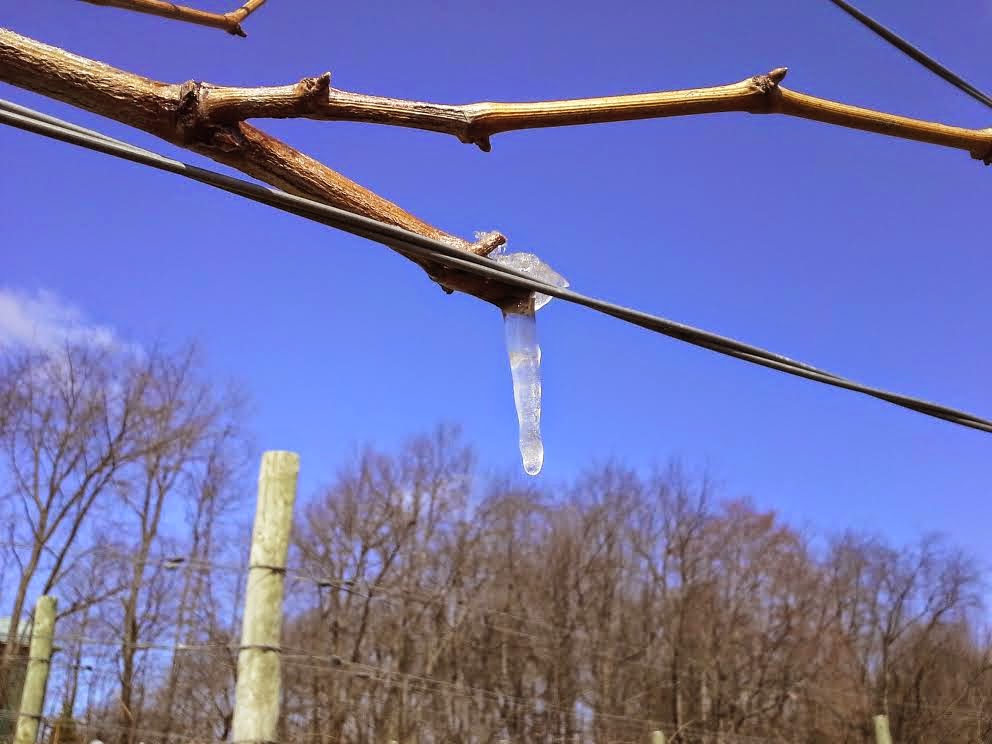 |
| "Sap sicle" from a pruning cut in the South Vineyard, April 15, 2015 |
A week after the blood moon, the buds are still alive, and continuing to swell. Any moment now, we will begin to see the pink and green foliage emerge from the earliest buds to break.
Grape vines exhibit apical dominance, which means the highest buds on each plant break dormancy first, and leaf out before the others.
For this reason, in our micro-climate, which is subject to heartbreaking late spring freezes, we leave longer spurs than are necessary on each plant when we do our winter pruning.
If anxious grape plants decide to break dormancy before winter decides it is ready to release us from its frosty talon, apical dominance ensures that we will have reserve buds lower on the plant to produce a crop.
This strategy of double pruning also means double the pruning labor, but is a necessary provision in our viticultural region.
 |
| A carafe of grape canes, forced to break bud. |
A few weeks ago, as one dismal report after another rolled in from vineyards throughout the Eastern U.S., I stuck a few pruned grape canes in a wine carafe of water. We'd examined the buds multiple times, tabulating the number of kiwi-green live buds we encountered on each sample cane.
We
knew the buds were alive. But still, just to be sure, we couldn't relax until we saw leaves emerge.
And so the other day, that hot house vase of grape canes broke bud.
Pink and green leaflets emerged first.
Then fully fledged leaves.
Now, a few days later, long green shoots, each with several leaves, emerging from the top bud on each cane, as apical dominance decrees.
Any day now, we hope to see the same thing happen on our vineyard vines.
And just like Betty the brown duck, who nests under our hydrangea bushes each year, as soon as our babies hatch, we will puff ourselves up a little bit and show them off.
Betty shows off here on our spring-fed lake, displaying her handsome brood in a neat row on the v-shaped wake she forms through sun-warmed water.
We in the vineyard will show off our equally handsome brood here on the interwebs. Any day now, once the buds break. Stay tuned...
(And we promise, this will be the last of the icy vineyard posts! I think we also said that in February. But this time, we really,
really, mean it!)
UPDATE April 28th:
One of the interesting things about growing grapes, is how localized conditions and micro climates can affect a particular vineyard. Interesting story in our hometown newspaper today about how the same conditions have had different effects at some of our neighboring vineyards:


