Showing posts with label swans. Show all posts

Wednesday, May 6, 2015

Leaf Out

An early May sunrise slowly burns morning fog from the lake.

Guiseppi, one of our resident mute swans, reaches his long neck up into a newly leafed-out willow tree.
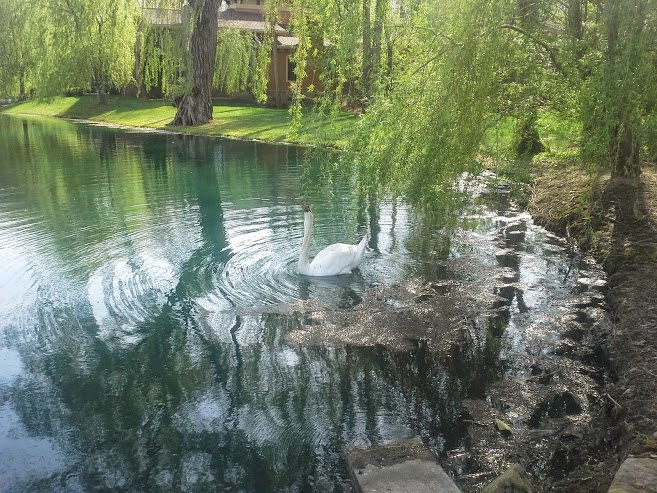

Just yesterday, it was colored with gold catkins. Today brings fresh green leaves.

He strips the tender new foliage from a weeping bough, and dips his spring salad into the water before eating.


Unlike geese, who grub voraciously through the turf for victuals, swans will only accept food submerged in water.

After a winter of sustenance pulled from sediment at the bottom of the lake, Guiseppe seems invigorated by his meal of fresh green leaves.


Those of us who tend the vineyard know just how he feels.

All winter long, we tromped through snow, pruning dormant brown vines. Spring brings mud, and the promise of new life.

And so May has dawned, and brought with it, welcome warm temperatures.

The soil warms, and welcomes the new vines  we nudge into it.

After a brutally cold winter, and a relatively cool and wet spring, the growth we see all around us in May is welcome, and rapid.

As if on cue, our earliest budding grape variety, Marquette, broke bud on May 1st.

Marquette block, North Vineyard, May 1, 2015
Each day, additional buds unfurl, slowly clothing the North Vineyard in fresh green foliage.

These warming afternoons will bring rapidly elongating shoots. We'll likely see several inches of new growth a day later this week, as temperatures climb into the eighties.


Elsewhere on the property, our later budding varieties continue to slumber. Swelling buds will continue to break open over the next several weeks.

In the fence rows and the orchard, blossoms abound.

Honey bees luxuriate in golden pollen, in apple blossoms that change from carmine to pink to white as they open.


Every year, all of this happens.

But the sequence is never precisely the same. 

Although this spring seems cool and damp, our Marquette vines broke bud nine days earlier than they did in 2014.

Bred in frigid Minnesota, it's as if our vines couldn't stand to miss a single May afternoon of pleasant Canton sun. I think Giuseppe, as well us we who tend the vines, feel exactly the same way.


Friday, March 20, 2015

St. Giuseppe


This year, like last, on the first day of spring a mushy late season snow fell in the pre-dawn hours.

Remnants of winter ice clung to the coldest corners of an otherwise warming lake.

In the vineyard our growing piles of winter vine prunings were blanketed once more in snow.

Marquette prunings in the North Vineyard
Despite the snow, however, the first indications of spring arrived in the vineyard just as they should:

For months buried in a thick snow pack, the turf in the vineyard rows is no longer ice crusted. It is now soft (and muddy) as the soil begins to thaw.

As as the soil thaws, capillary action in the vines pulls excess moisture from our old farm soil, a currently water-logged silty loam.

As the temperatures begin to rise, each of our thousands of vineyard pruning cuts begins to bleed: a good and welcome sign that the vines are alive and waking up after one of the coldest recorded winters in our region.

As the soil awakens, the plants will follow.

Down in the marsh, the (aptly named) skunk cabbages melt their own microclimate, sheaths of red mottled leaves arising steamily through the mire. They will bear early (and malodorous) flower, weeks before those plants on drier ground have even begun to show green.


And of course the vineyard animals are newly astir.

The killdeer have returned to chirp noisily through the vineyard rows, where they will build pebble nests under the vines.

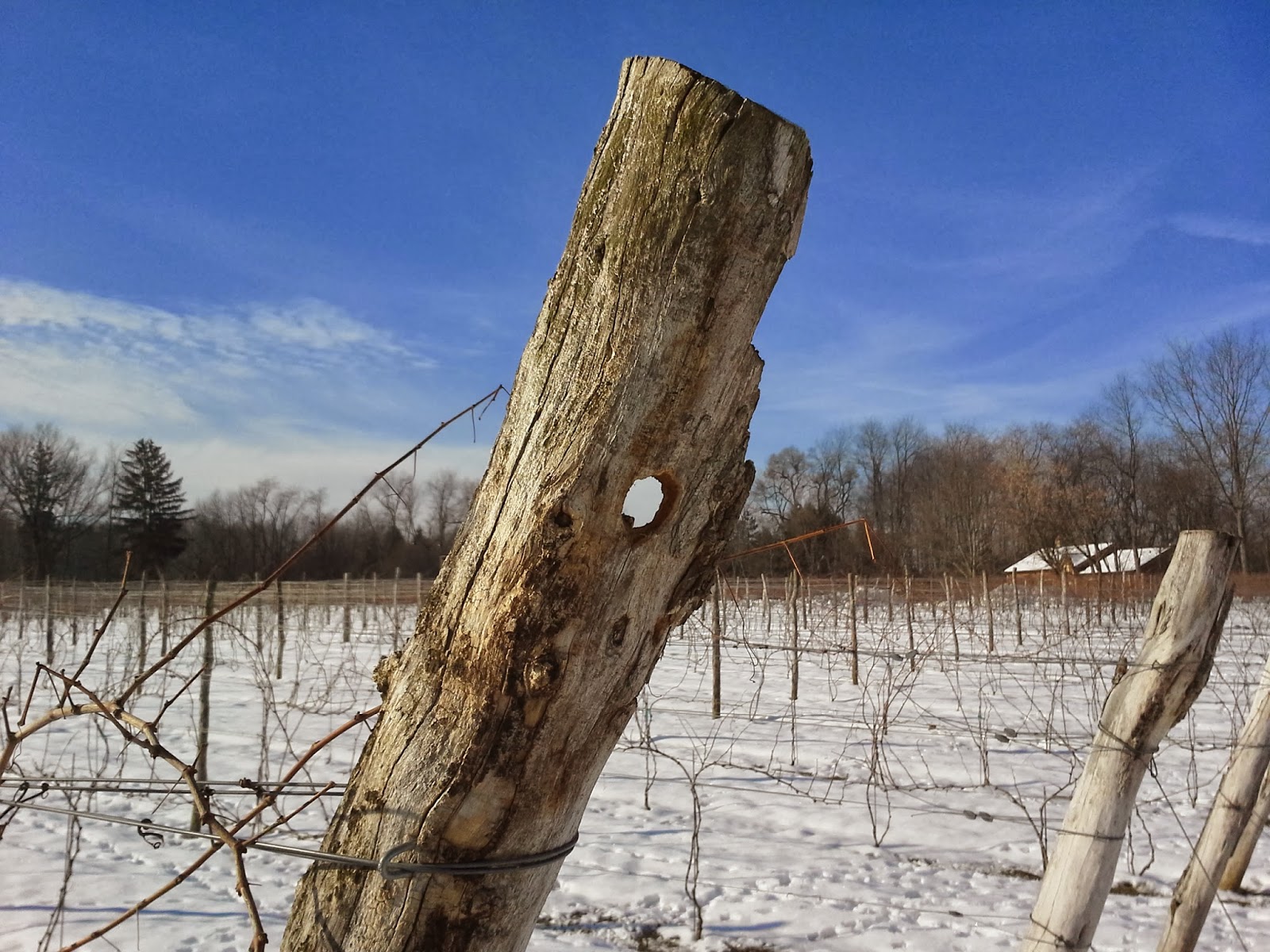
Bluebirds cheerfully negotiate for the choicest knotholes in the trellis poles.

And of course, seasonal drama unfolds amongst the waterfowl.

Giuseppe, our large male swan, hurumphed his way through the vineyard yesterday, in hot pursuit of an errant Canada goose.


Silly goose.

Anyone who's seen Giuseppe glide regally across our lake knows that this is undeniably Giuseppe's terrain.

You don't just show up with your bags packed, as the goose pair did, expecting to build a down feather nest under a pine tree.

If Giuseppe looked especially proud and puffed up yesterday, it might be because he knew it was St. Giuseppe Day.

Giuseppe and Gina
Falling on the eve of the Vernal Equinox, the Feast of San Giuseppe is traditionally a time to set an elaborate table in honor of St. Joseph, patron saint of children and of families.

And so, in the vineyard, it seems fitting on this day to pause for a few minutes, and watch resolute old Giuseppe defend his family home.

The first day of spring, under gray skies and just a little bit of snow.

The Vernal Equinox: a time to pause, and appreciate subtle spring awakenings.

Today, the daylight hours will be exactly as long as the night.

Tonight, the March New Moon will create an especially dark sky, perfect for stargazing.

An ideal time to pause, perhaps to enjoy a zeppole pastry topped with black cherries. (It's okay to take a brief respite from Lenten austerity, St. Joseph is also patron saint of pastry chefs).

A time to perhaps open a special bottle of wine, and savor the brief lull before the full flush of spring. (Which the blooming of the skunk cabbages tells us, is just around the corner.)


Tuesday, November 18, 2014

Denizens

It's a little quieter on the grounds this time of year.

The tables on the Piazza are stowed for the season.

No festive pavilion weddings.

So the swans seemed a little curious about this new vineyard denizen.


He must have arrived last night, staying in the farmhouse,

Although statistically, we don't get a lot of snow in November, and to some this seems early, in the vineyard, we welcome it.

Our vines need cold weather early in the season to "put them to bed."

And at this point in the season, before the vines are fully hardened off, the snow is a welcome blanket, insulating the roots just a bit, until they achieve full dormancy.

Cold temperatures in November, and a bit of snow, are exactly what the vines want to see.

The swans, on the other hand, aren't so sure.


Thursday, April 10, 2014

Quickening

Suddenly, with a flip of the calendar page, everything has changed amongst the birds.

Winter was a time to hunker down. 


Enormous flocks of Canada geese wintered with us, slumbering en masse at night on the iced lake, by day grubbing voraciously through a mantle of snow to pluck victuals from the turf. In their wake, a cacophony of churned earth and webbed foot prints.

Of a January vineyard morning, I would crunch through diamond-crusted snow before sunrise. 

At sunrise, coming to a small patch of open water, and the flotilla of ice where our swans slumber, I would feel like I'd entered a secret avian dream world: All is peace and crystalline beauty

The swans allowed a small trusted bevy of geese to sleep amongst them on their floating bed chamber, the rest banished to the lakeshore with the ducks. How very wise, I thought, to have these squawky sentries close at hand during the vulnerable silent hours.

During those peaceful winter mornings, I would observe that our ducks never sleep on the ice, except when there is a downy blanket of snow. On a snowy January morning, I arrived at sunrise to find our entire duck colony asleep on snowy ice. They rose with the sun, and begin chattering amongst themselves, waddling busily on the ice. (I think I could be content to watch ducks walk on ice all day.)

But change is afoot in the vineyard, the quickening of the year. 


Maple buds swelling against an April sky.

Skunk cabbage shoots rise steamily from the creekbed. 

Gliding raptors, aloft in a sky that is suddenly cerulean, dangle entrails of branches. 

On a rainy morning I notice our pair of mute swans display a newfound interest in golden willow branches that litter the lawn.

These quickening days, and an ever changing sky:

To the South, golden rays, impossible blue skies, fluffy white clouds.

Northward, impending wintry nebula, dark and foreboding. 

On many days snow flurries mixed with drizzle and warmth. 

This fleeting season, marked by the mysterious arrival of impossibly vivid ducks, with crimson necks. 

Raw, windswept March has just passed, when you would experience all of the seasons in just one day.

But gone now is March, and with it, the mysterious crimson ducks that visit each winter, then disappear as quickly as the whiteout flurries that sometimes materialized to displace a mid-afternoon sun.

The day the crimson ducks departed marked a noticeable change in avian behavior. 

All winter everyone got along, but the day the ducks left, our territorial male swan was suddenly bound and determined to keep a pair of Canada geese from nesting under a cherry tree. I could swear they are the exact same pair that tried to nest here last year, under a pine tree that is now gone. 

As the days lengthen, gone are the large colonies of ducks who gobbled at the swan chow bowl on frigid winter days.

Gone the riotous gaggle of geese who slumbered on the ice by night and rooted riotously through vineyard rows for daytime grub.

Gone the marauding robins who came out of nowhere to strip to bare twigs a crabapple tree which had somehow held its fruit through Christmas.

On these suddenly sunny April days, the birds have all paired off:

The swans daub a nest from mud and leaves and willow branches in a swampy finger of the lake.

An iridescent mallard and his handsome brown speckled bride toddle about the shrubbery at sunrise, looking for a place where in a few weeks she may deposit her eggs.

A pair of elegant mourning doves coo beside an old grape press in the rose bushes, seemingly grateful for the now bare earth on which to roost.

There is something to be said for days spent tending a vineyard. 

Even days that sometimes start with pelting sleet and a glaze of ice. 

And especially days during this magic season, when the year quickens perceptibly, and avian behavior takes a marked seasonal turn. 

An entire complex avian world goes about its seasons on the shore of this lake, and we feel privileged to be here to watch it unfold.

And throughout it all, in every season, a solitary Great Blue Heron swoops overhead, knowingly. (And sometimes, I kind of get the feeling that heron is orchestrating the whole thing.)


Skunk cabbage steamily rises.

Thursday, March 6, 2014

Red

Our 1952 Farmall Tractor rests at the edge of our north vineyard. A mantle of sparkling snow still lingers upon it. In the frigid March sun, its red steel glows preternaturally bright.


With apologies to the poet William Carlos Williams, who wrote so memorably so many decades ago about a now-famous red wagon glazed in rain,

so much depends
upon
a red tractor
glazed with ice
crystals
beside the white
swans.

This remarkably bright March morning, which is also remarkably cold, our snowy tractor seems to epitomize where we are in this most unusual winter season.

Normally all the apple trees in the orchard would have been pruned months ago. 


In the vineyard, we would be going through and doing a second round of pruning, to adjust the number of buds. We would begin to see the buds swell, the fuzzy down under the shiny red outer scales starting to emerge.

Of course, there is no such thing as a “normal” winter. If we harken back two Marches ago, we were sweltering in an unprecedented string of 80 degree days.

But this winter, time seems to stand still. 

It is no warmer in March than it had been in January.

The grass is still mostly crusted in snow.

The snow around Bucky the vineyard groundhog’s winter den remains untrodden.

The vineyard is still mostly unpruned, as we monitor the effects of temperatures not recorded in decades, in this the winter of the  vortex, the winter of Janus.

The vineyard sleeps.

The tractor rests.

Its red paint glows in cold but bright sun.

But on schedule, the red headed ducks that appear every February returned to Lake Gervasi a few weeks ago. They have joined our iridescent mallards, and our patient, regal swans, who circle a small patch of open water waiting for the day they may begin gathering willow branches for their yet-to-be-built nest.

The predicted arrival of the migrating ducks with the startling gray backs and crimson heads lets us know that although we are poised in a lingering chill, the days are lengthening.

The sun, though cold, is bright.

Grape vine pruning will proceed double time as soon as conditions allow. In the meantime, we cut open shiny red grape bud scales, to see if the tissue inside is vivid green, and therefore, alive. (So far, our very cold hardy Minnesota and Cornell-bred vines are holding up well.)

Perhaps I will leave our vineyard swans some grape canes, to augment the willow boughs in the construction of their still un-built nest. Red canes entwined with golden willow branches seem fitting, somehow, for a late-breaking spring.


Friday, February 14, 2014

Romance


Although an ancient and widely celebrated holiday, the origins of St. Valentine’s Day as a celebration of romance remain strangely murky.

And yet, going back to some of Europe’s oldest folklore, this has always been a day associated with, perhaps surprisingly, birds.

In Geoffrey Chaucer’s ‘The Parliament of Fowls’ (circa 1381), birds gather at the bower of “the noble goddess Nature” to settle love rivalries:

For this was on saint Valentinës day
When every fowl cometh there to chose his mate.

And so it went, through the centuries, February 14th was deemed the day the birds select their mates. (Which may work well in more temperate Europe, but particularly in a winter such as this, mid February is rarely the finest day to go a-courtin’ in our climate.)

Perhaps because vineyard work is largely solitary work (and grapevines are not particularly chatty) those of us who tend the vines often feel an affinity with the critters who share the landscape with us, and Gervasi Vineyard's diverse fifty-five acres of vineyard, woodland, fallow pasture, and wetlands support a particularly lively community of birds.


Knotty locust vineyard poles.
  • Barn swallows and bluebirds nest in the holes in our natural locust trellis poles, helping to control the insect population and keeping our grapevines healthy.
  • Chirpy killdeer build pebble nests on the open soil below the vines, depositing speckled eggs perfectly camouflaged amongst smooth glacial stones.
  • Eagles and hawks swoop majestically above our old crop fields, while sharp-kneed Great Blue Heron fish patiently in deep pools along the meandering creek that transects this, the last working farm in Canton, Ohio.
Among all of these creatures, however, it is clear that one pair rules the roost: Gina and Giuseppe, our regal pair of white mute swans.


During winter months you might find them bedded down on snow nests they build on ice patches on the lake.

If we ever get some warm days this winter, you will find Giuseppe diving down to the deepest muck of the lake, to begin daubing a leaf, mud, and willow branch throne for his lovely bride, Gina.

It is during the summer months, however, that Gina and Giuseppe are in their element. On certain crystalline Tuscan afternoons, when the afternoon light is perfect, Gina and Giuseppe glide in to view. They pirouette, dive and splash extravagantly, and, on occasion, touch bills, elegant necks joined together as a heart, perfectly reflected in still blue water.

Being mute swans, of course they cannot speak, but we like to think this is their way of saying Benvenuto!

Because mute swans mate for life, Giuseppe does not need to enact the ancient folkloric ritual of choosing a new mate each February 14th.


But if you are strolling our grounds this snowy Valentine’s Day, or any day of the year, and you happen to encounter our regal pair touching bills to form a heart with their elegant necks, consider it your personal welcome to Gervasi Vineyard, and the romanza of this place.