Showing posts with label folklore. Show all posts

Thursday, February 2, 2017

Midway

We have reached the midpoint of winter.

February 2nd, halfway between the winter and spring Equinox, is traditionally a day for farmers and those who tend the earth to pause and look forward.


In North America, ancient traditions have coalesced into Groundhog Day. Somewhat tongue-in-cheek, we look to our largest native North American rodent to prognosticate about what the future may hold.

Few animals in our region truly hibernate, even in the coldest of winters. There is a surprising amount of animal activity around us all winter long as we perform our winter vineyard tasks. In fact, in seasons where we have consistent snow on the ground, the volume and variety of tracks in the snow reminds us that open fields and woodland edges are heavily populated with a variety of creatures, most of which we never see.


And though our vineyard groundhogs have been with us all winter, we nevertheless have a little fun each season trudging out to their burrows, to see if one emerges to see his shadow on this particular day.

These latter days of winter are a fabulous time for shadows. Winter skies are often clear, ever increasing light comes down in a dramatic slant across an austere landscape.

The shadows of unpruned vineyard sections inscribe something that looks like a fantastical musical staff.


Our own trudgings are thrown in sharper relief, as are the slithers and scampers of vineyard denizens.


Trees cast long shadows across the lake.


The familiar profile of wild turkeys foraging crabapples in faint pre-dawn light is a familiar morning sight.

The rhythm of animal and plant life is fairly consistent across the seasons.

But of course, each winter can be very different than the last. The winter of 2014 and the winter of 2015 were especially memorable.

This year, snow has been rare.

By all accounts, this has been a very wet, and very warm winter: not ideal conditions for the grapevines, as it can stimulate them toward growth in the month when they should be most dormant.

There is a lot of winter still to be had.

For those interested in the prognostications of our resident Marmota monax: our vineyard groundhog did NOT see his shadow this morning.

A band of snow showers blotted the sky at sunrise, and briefly dressed the mud in a thin layer of flakes.


Which, the oldtimers contend, means warmer than usual conditions may well continue through these waning days of winter.

Our vineyard denizens will increase their activity as the days grow longer. As for our grapevine buds, we hope they remain fully asleep at least a few months longer.

Bud burst May 2015


Tuesday, September 30, 2014

Tradition

2014 Festa Gervasi Wagon

If you do something twice, it's a tradition, right?

And so it is with our harvest wagon.

Last year, for Festa Gervasi, our grape harvest festival, we had great fun putting together our inaugural harvest wagon.

Building on Italian grape harvest traditions, we thought it would be fun to transplant the tradition to Canton, Ohio.

Everything on the wagon comes from our acres:

Scrap lumber left from construction, wild flowers from the meadows, bedding plants from our grounds, grapes from our vineyard.

I don't think anyone would ever guess that below our inaugural wagon was our aluminum airboat trailer.

Well, for this year's wagon, we started inauspiciously with pallets.


And loaded it up!


We look forward to continuing this tradition each year.

Each harvest, like each season, has its own personality and traits. And we look forward to each wagon looking different from those that came before.


Friday, February 14, 2014

Romance


Although an ancient and widely celebrated holiday, the origins of St. Valentine’s Day as a celebration of romance remain strangely murky.

And yet, going back to some of Europe’s oldest folklore, this has always been a day associated with, perhaps surprisingly, birds.

In Geoffrey Chaucer’s ‘The Parliament of Fowls’ (circa 1381), birds gather at the bower of “the noble goddess Nature” to settle love rivalries:

For this was on saint Valentinës day
When every fowl cometh there to chose his mate.

And so it went, through the centuries, February 14th was deemed the day the birds select their mates. (Which may work well in more temperate Europe, but particularly in a winter such as this, mid February is rarely the finest day to go a-courtin’ in our climate.)

Perhaps because vineyard work is largely solitary work (and grapevines are not particularly chatty) those of us who tend the vines often feel an affinity with the critters who share the landscape with us, and Gervasi Vineyard's diverse fifty-five acres of vineyard, woodland, fallow pasture, and wetlands support a particularly lively community of birds.


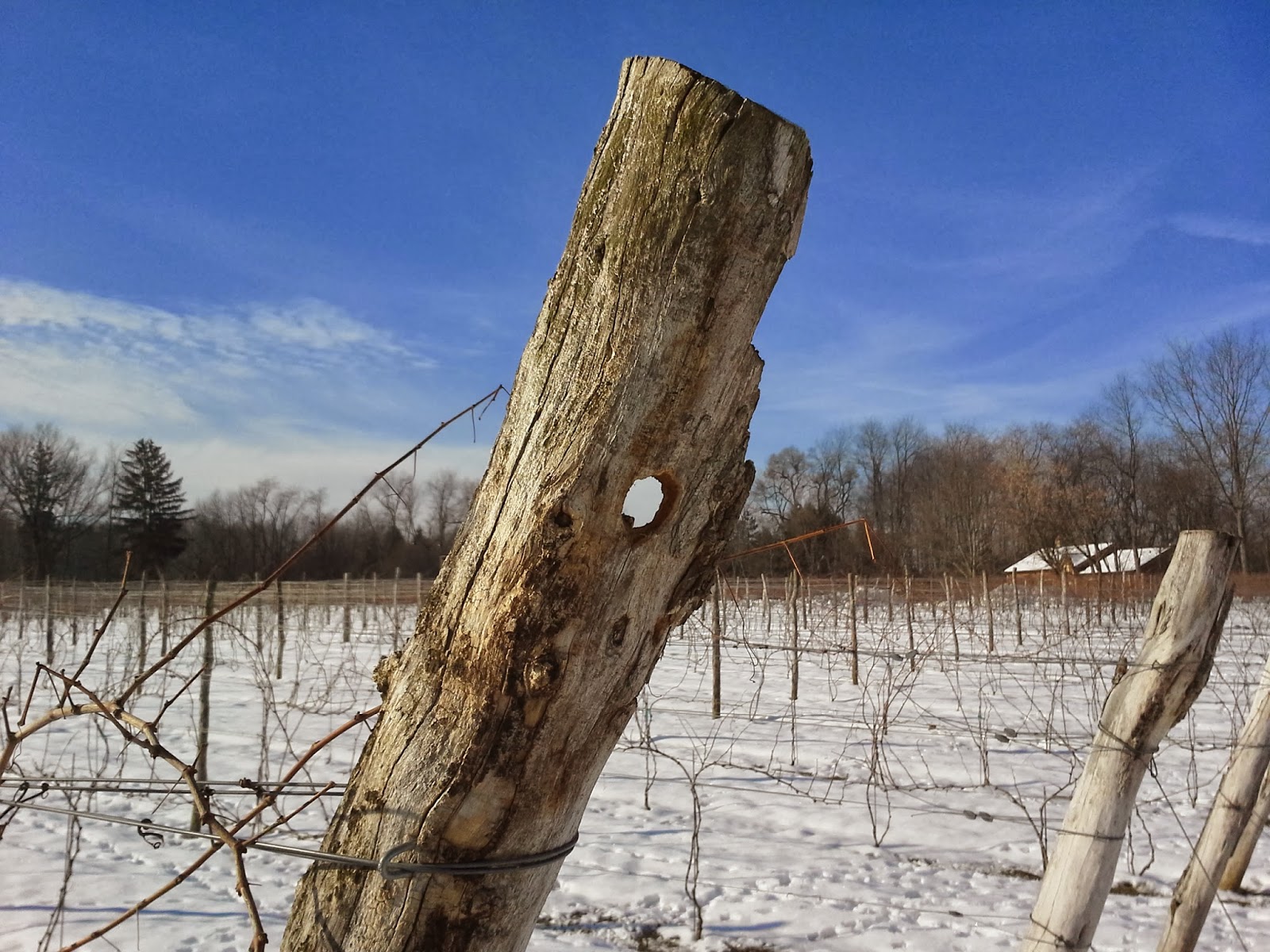
Knotty locust vineyard poles.
  • Barn swallows and bluebirds nest in the holes in our natural locust trellis poles, helping to control the insect population and keeping our grapevines healthy.
  • Chirpy killdeer build pebble nests on the open soil below the vines, depositing speckled eggs perfectly camouflaged amongst smooth glacial stones.
  • Eagles and hawks swoop majestically above our old crop fields, while sharp-kneed Great Blue Heron fish patiently in deep pools along the meandering creek that transects this, the last working farm in Canton, Ohio.
Among all of these creatures, however, it is clear that one pair rules the roost: Gina and Giuseppe, our regal pair of white mute swans.


During winter months you might find them bedded down on snow nests they build on ice patches on the lake.

If we ever get some warm days this winter, you will find Giuseppe diving down to the deepest muck of the lake, to begin daubing a leaf, mud, and willow branch throne for his lovely bride, Gina.

It is during the summer months, however, that Gina and Giuseppe are in their element. On certain crystalline Tuscan afternoons, when the afternoon light is perfect, Gina and Giuseppe glide in to view. They pirouette, dive and splash extravagantly, and, on occasion, touch bills, elegant necks joined together as a heart, perfectly reflected in still blue water.

Being mute swans, of course they cannot speak, but we like to think this is their way of saying Benvenuto!

Because mute swans mate for life, Giuseppe does not need to enact the ancient folkloric ritual of choosing a new mate each February 14th.


But if you are strolling our grounds this snowy Valentine’s Day, or any day of the year, and you happen to encounter our regal pair touching bills to form a heart with their elegant necks, consider it your personal welcome to Gervasi Vineyard, and the romanza of this place.

Monday, February 3, 2014

Shadows

February 2nd has come and gone, which means the sun has just passed the halfway mark on in its journey from the winter solstice to the spring equinox.

The days grow perceptibly longer.

Which also means North America's largest rodent has just had his day in the sun (or shadows, as the case may be).

Marmota monax, the common North American woodchuck.
The famous Pennsylvania rodent has been roused by a gentleman in a top hat from his rather well-appointed den.

Here at the vineyard, Bucky, our resident Marmota monax has yet to stir.

His rocky den, on a sunny vineyard slope under a Petite Pearl grape vine, is still blanketed under an undisturbed snow:


Of course, this may or may not be the den where he is sleeping, as groundhogs are known to construct multiple chambers, the winter quarters often more secluded than the summer lodgings.

But this is where he was last seen, on one of those golden autumn afternoons, when the sweet gum trees blazed orange along the creek bed, and the enormous cottonwood by the bridge glowed amber.

Given that we are coming off one of the coldest Januaries in memory, and the East Coast is forecast to be blasted again this week, our resident rodent's extended slumber is not unexpected, nor does his Pennsylvania cousin's notoriously inaccurate prediction of an extended winter seem far off this time around.

As we trudge through the frozen vineyard rows doing winter pruning, we perhaps feel a kinship with those agrarian immigrants from long ago, who brought from Europe their ancient seasonal folklore, substituting our portly North American woodchuck for the black and white striped badger who was the European prognosticator of Spring.

This midpoint of winter, we are desperate for any sign of reassurance, so it is natural to look toward our familiar vineyard denizens for impending change.

Our sharp-kneed Blue Heron, who lives in the reeds, has been a bit more visible of late, swooping majestically over the lake, on warm days when the sun opens up some water.

Footprints reveal Mr. Muskrat has made a few furtive forays from his willow tree den, not making it far before circling back home.

I will continue to be on the lookout for Bucky, our somewhat reticent vineyard woodchuck, who in the summer perches on his stubby hind legs as a silent sentinel in the South Vineyard, until he sees me and lumbers back to his rocky warren at a surprisingly fast clip, for a gentleman of such ample proportion.

Until Bucky rouses himself, it is to our swans I will look as true harbingers of spring.


These days at sunrise I arrive to find Gina and Giuseppe hunkered down on snow nests atop an icy lake.

But some day soon, around the time newly amorous skunks perfume the sunrise, I will arrive to find Gina and Giuseppe swimming along the shore, with a new found interest in twigs and branches.

A flurry of activity will ensue, and once Gina is enshrined atop her floating twiggy throne, we will know it won't be long until the vineyard buds break.

Until then, Bucky continues to slumber.

Sleeping off, I imagine, a late autumn indulgence of overripe grapes.

Monday, October 28, 2013

Frosty Vineyard Roses

Every vineyard morning at sunrise, something catches my eye.

This morning it is the roses.


There are reasons to plant roses in a vineyard:

Tradition

Roses do well in sunny well drained soil, as do grapes. Someone figured that out a long time ago, and somehow, the two just complement one another. On certain sunny summer days, when the roses are a radiant red, and the sky a beckoning blue, this corner of Canton, Ohio really does feel a little bit like Tuscany.

Canary in a Coal Mine

Suited to dry and sunny climates, the two plants can succumb to blights and mildews and pests that thrive in our borderline tropical summer climate.

Blights on the roses indicate that our vines may be at risk. A romantic notion, perhaps, in an age of scientific viticulture, but there is something to be said for interspersing a second species, among acres of thousands of the same plant.

A Rose Is A Rose Is A Rose

I have yet to use a rose bush to diagnose a serious ailment in the vineyard. (And regardless, the rose varieties we grow are modern disease resistant hybrids.)

A vineyard rose has a far more important function: It is a rose.

A thing of beauty, resplendent red amongst acres of green. Rampant vines with inconspicuous blossoms but laden with abundant showy fruit, contrasted by thorny shrubs with luxuriant blossom but subtle fruit.

Terroir

Another romantic notion, with some base in science, is that of terroir, that the grapes of a vineyard reflect the local micro conditions of climate, soil, air flow, quality of light, and minerals that are endemic to a particular spot on the earth.

It stands to reason, therefore, that somehow, someway, the visual beauty of the vineyard landscape finds its way in to the wine it produces: the soul of the vineyard in the taste of its wine.

And this being an Ohio vineyard, it stands to reason that the roses we grow should not just look resplendent  under a Tuscan summer sun, but should array themselves beautifully in our full range of Midwestern seasons.

On this October vineyard morning, I think our frosty vineyard roses pass that test.

Sunday, September 29, 2013

La Vendemmia, Canton-style

Our Festa Gervasi harvest wagon is a transformation of the Italian La Vendemmia tradition, when the last grapes from the vineyard are ceremoniously hauled to the village in a decorated wagon, traditionally borne by oxen. Grape stomping and festivity ensue.


Our wagon celebrates not just the bounty of the harvest, but tells the story of this place, from virgin oak forest to dairy farm to tree farm to vineyard.

Instead of a team of oxen, our Canton harvest wagon is borne by our antique McCormick Farmall, refurbished and used to till our vineyard rows.


Baskets of apples and pears from our orchard, and walnuts from our fence rows (standing in place of Tuscan olives), speak to the rural heritage of this corner of Canton, Ohio.
Colorful sweet gum and maple boughs mark the years a tree farm stood on these grounds, and are joined by asters, goldenrod, and rose hips from our meadows, which are nearing their peak of fall color.

Wooden signs represent the six varieties we have chosen to nurture to fruitful maturity in our young vineyard: Marquette, Frontenac Gris, Aromella, Arandell, Vignoles, and Petite Pearl.

An oak wine barrel from the Canton Cooperage company commemorates the virgin oak forest that once stood on this site, remnants of which can be seen in the restored oak beams of our Bistro, a renovated 1823 Ohio bank barn.

Garlands of wild grape vines from our woodlands wrap the wagon, in homage to Ohio's vineyard heritage, and the American lineage of some of the French-American hybrids we grow.

The wagon itself is made of scraps of lumber from our new Crush House, and a few boards from the old barn which housed our initial wine cellar, in celebration of vintages past and future.

Baskets of summer flowers from our meticulous grounds, recently pulled to be replaced by fall plantings, are another marker of seasonal change.

The work of the vineyard goes on through all seasons and conditions. When harvest and its vibrant colors arrive, it is more than just a pretty scene, but a celebration of life and abundance.