Showing posts with label phenology. Show all posts

Friday, October 30, 2015

Blaze

Autumn’s glory descends on our corner of Stark County, Ohio.


In our neighboring crossroads cemetery, a weathered limestone maiden, missing an arm, maintains her perch atop a stone pedestal. She surveys the blaze of sugar maples, late but resplendent in their color this year.
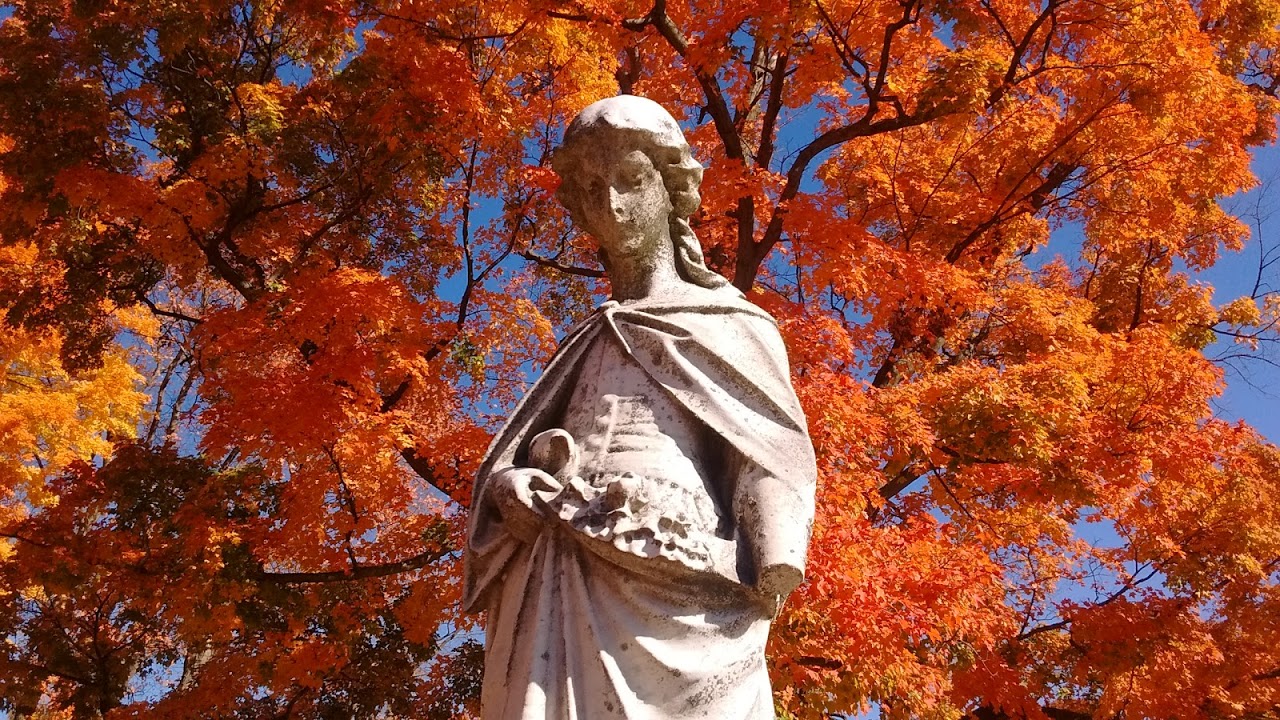

In just a few days, the shortening days and lengthening rays of autumn light have drastically changed the colors in the scenery all around her. Her stone countenance, impassive, takes it all in.

Having surveyed this crossroads plot of gravestones and maple trees for decades, I imagine our stony maiden has gained enough wisdom to avoid declaring this year’s fall color better than that of any other.

October 5, 2015: Aromella vines in the South Vineyard begin to display their varietal fall color.
I have only tended the vines in the neighboring vineyard for half a decade.

But in those years of watching the seasons unfurl and then retract, I have absorbed the deep seasonal rhythms of this fixed spot on the globe. I have learned that no one season is like any other, and comparisons between them are hard to make.

Through every season, we observe and record sequences:

October 15, 2015: sweetgum branch against marsh reeds
In the spring, we anxiously record for our phenology log when the wild plants on our farm break bud and then set flower. The first to emerge, melting a hole through the snow covering them, are the skunk cabbages, arising steamily in the marsh with an aroma of carrion to entice flies and wasps, the season’s first pollinators.

October 19, 2015: late ripening apples in the orchard
Months later come the apple blossoms, wafting a sweet scent across the orchard to attract the honeybees.

Although the sequence remains largely the same, the calendar dates of when plants choose to leaf out and then blossom varies from year to year, as does the exact overlap of when various species are in simultaneous bloom.

In a year when many things bloom together in a flowery riot, it is easy to declare that it is the best spring ever.

But then comes a season when blossoms are more evenly spaced, the season’s flowering more staggered. The staggered season is perfect in its own way: a chance for us to appreciate each flower, a chance for the honey bees to enjoy a more consistent diet of varied nectar.

Once summer arrives in the vineyard, it is the rainfall and accumulation of growing degree days that we observe and record.

Newly furrowed vineyard rows in North Vineyard, couched by October frost.

The flavor of the grapes we harvest are a record of the heat and relative wetness of the summer that ripened them.

In our minds, there is always a perfect ideal for the balance of sweetness, acidity, and juiciness that we hope the ripe fruit will attain.

Frontenac Gris block, North Vineyard: early leaf fall this year.
But no growing season is like any other.

The humans who tend the vines can do some things to subtly affect ripening: we can pull more or fewer leaves from the green buckshot berries to encourage and speed ripening, we can limit the size of the crop to condense the plant’s energies into fewer, more flavorful clusters.

But what happens on the vines is largely a product of the season, and the effect of our human efforts, subtle.

Like the stone-faced cemetery maiden, we learn to regard each season, and each vintage, as its own perfection: it is what the earth yielded.

We may prefer an autumn when the Virginia creeper, the sweetgums, and the sassafras all blaze together.

But some years the season chooses to color each one on its own schedule.

Sassafras foliage along North Vineyard, dispalying varietal leaf shape variation.

And so in the vineyard, in the last days of October, we find ourselves in the season of senescence, when this summer’s green and rampant shoots finish hardening and maturing into next season’s fruiting canes.

South Vineyard, October 24, 2015

Last year, the grapevines luxuriated in a lazy, lengthy cane ripening season: our vineyard was striped with each variety achieving its fall color in its own sweet time, the leaves fully maturing, then falling to the ground.

Frosty vineyard roses, October 20, 2015

This season’s foliage color and cane ripening was more condensed: a hard frost on the morning of October 20th kissed the vineyard roses, and before the afternoon was over, green and golden grape leaves that were frost crusted at sunrise were brittle and brown, hastening the dormancy of the canes, signaling the end of the growing season.

October 20, 2015: Morning sun melts frosted grape foliage. By afternoon, the leaves will shrivel and shed.

As perennial woody plants, our vines accumulate the events of each season. Next year’s vintage will be a record of not one season, but all those the plant endured before it.

We watch.

We record.

We hope to gain the patience, and the wisdom, of the weathered cemetery maiden.


On a radiant October afternoon, slanting autumn sunlight colors the lake a deep blue and reflects the crimson of maples, the golden orange of sweet gum, lingering despite a recent storm.


Our swans, sturdy swimmers, struggle to remain upright as remnants of a tropical storm whip the usually tranquil waters into choppy peaks.

The lake is full to the brim with fresh rainwater, and with the emergence of welcome afternoon sunshine, the swans dive and splash extravagantly, exhibiting what to my eye seems something like gratitude, for this day, for this season, for this final blaze of autumn glory, before the next season unfolds, with whatever it may bring.


Thursday, April 30, 2015

Planting

April, a month of blue skies and pleasant breezes, has come to an end.

Red maple buds and golden willow catkins against an April sky.
In the vineyard, the vines are doing exactly what we want them to do in this pleasant, amiable month:

Slumbering.

Those who grow grapes for a living track the phenology, or growth stages, of the vines each season with something known as the Eichorn-Lorenz scale. Right now, we are at what's known as the doeskin stage of bed swell: the buds are swollen, but not open, with brownish wool clearly visible.

A "doeskin" bud on the verge of burst.
A few more warm sunny afternoons, and the first tender green leaves will emerge.

In Canton, Ohio, we are subject to potential spring freezes well into May, so it's reassuring to have reached the end of April and find our emerging grape leaves still tightly folded, insulated with doe skin.

The only green grape leaves we see so far are on a few baby plants we propagated in the greenhouse over the winter, ready to move from protected shelter to the great outdoors.

A young Vignoles vine propagated over the winter from a dormant cutting.
So in the lull while we await the unfurling of  leaves out in the real world, we find ourselves looking ahead to a few harvests down the road:

We are planting bare root grape plants, which won't bear fruit for another two to three seasons.

The soil is finally warm enough, and we dig a big enough hole in the crumbly loam to accommodate the ample roots of bare root plants we received in the mail.

A bundle of bare root Vignoles vines awaits transplant.
The wine grapes we have chosen to establish in our vineyard have proven remarkably hardy, but every year there are just a few that don't make it, and need replaced. With several acres and thousands of vines, even just a fraction of a percent of loss can mean several pleasant April days of digging, and planting.

In the vineyard, the leaves emerge before the subtle yellow grape flowers, which we likely won't see until June.

But in the orchard, flowers precede the leaves, so we close April enjoying apple and pear blossoms decorating each tree.

Pear blossoms in the orchard.
With the turn of the calendar page, tomorrow ushers in a month of even more rapid growth and change.

In May, doeskin will give way to delicate pink and light green grape leaves, which if they survive a late frost, will grow into the enormous tough leaves and rampant shoots we will struggle all season to contain.

In the vineyard, it's always just a little bit hard to let pleasant April go, even as we plant for future bountiful harvests.

Wild apple blossoms decorate a fence row.

Friday, May 9, 2014

Burst!

May 6, 2014: First apple blossoms in the orchard, three days before vineyard bud burst.


I try to keep this blog close to target, talking about grapes and viticulture (with occasional diversions into swan husbandry and the way snow looks in different permutations of winter sky.)

So bear with me a bit today if it seems like I'm rambling...but it all circles back to what is going on in the vineyard right now, the season of the vineyard with the appropriately explosive name: Bud Burst!

One of the wisest women I ever knew, was Mrs. Jane Reynolds.

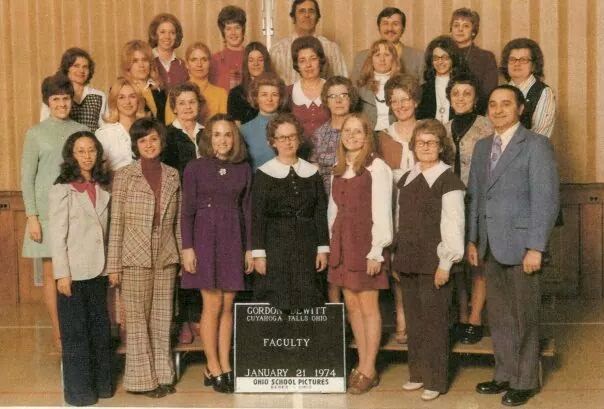
She was my third grade teacher at Gordon M. DeWitt Elementary School in Cuyahoga Falls, Ohio.

DeWitt School faculty, 1974. Mrs. Reynolds, second from right, front row.
She passed away several weeks ago at the age of 97, after a long and purposeful life.

Although my calculations may be way off (since I was barely four feet tall at the time) I am pretty sure she wasn't much taller than 5'1", and what a dynamo of energy she was.

(Tongues still wag over an mid-1970's last-week-of-school Field Day, where she jumped into the Tug-Of-War, handing decisive victory to her underdog 3-1 grade class, over Mrs. Villemein's much favored 3-2.)

What I remember about her was not just that she was a fantastic teacher, and that she did all the things the other good teachers did, but that she somehow managed to squeeze into each day, and each class, even more than everyone else did.
Above all, I remember her boundless energy.

In addition to her full-time teaching job, she and her husband, Mr. R. O. Reynolds, the retired band director at the high school, had recently moved to and were restoring her ancestral family farm.

(I learned from her obituary that her great-great grandfather had walked from New Hampshire to Ohio to stake a claim on the Western Reserve, and that was the farm she and her husband were restoring.)

Whatever was going on on the farm in a particular season, she would bound into the classroom with examples to show off: The first puffy pussy willow buds of the season. The first drips from the maple buckets during sugaring days. Branches of crabapple in full bloom. The season's first chirpy fluff chicks.

So, for several weeks now, I have been hauling my vase of grape canes around, showing off to anyone who will listen the magic of the buds unfurling, the abundant life inside each inauspicious hard scaly brown bud, which needs just warmth, sunshine and water to unleash abundant green life stored within.

And now that season we had been forcing indoors under hothouse conditions is happening spontaneously in the vineyard acres around us.

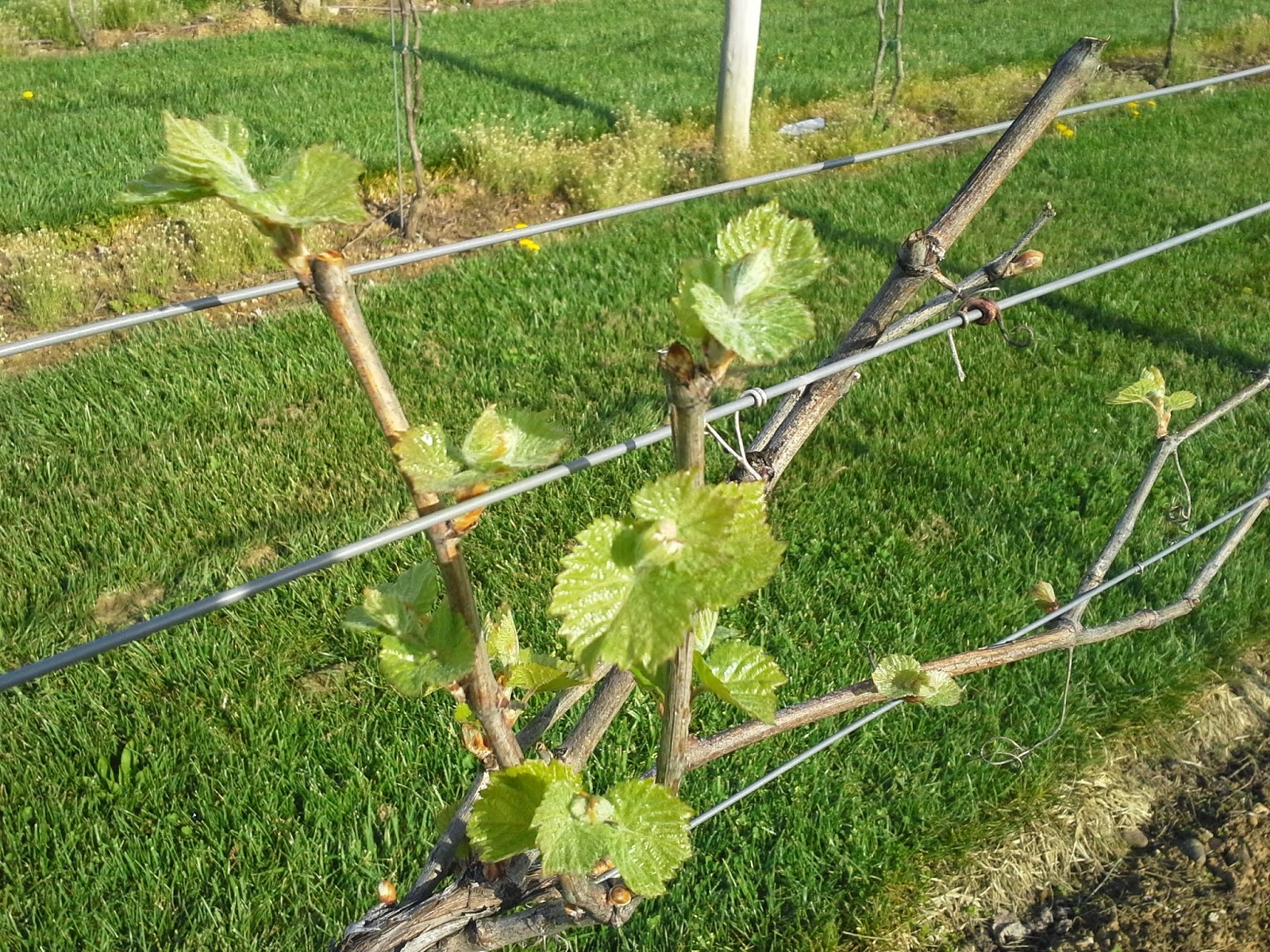
May 9, 2014: Ladies and gentlemen, we have achieved BUD BURST.

May 9, 2014: First leaf on the Marquette vines, North Vineyard
After months of work amongst dormant grape canes, and then weeks surrounded by fragile swelling buds, we now see the first green grape leaves of the season.

And what a welcome sight.

It's a day we have been anticipating: each day since the soil started warming (ever so slowly this year), we have been scouting our fifty five acres as we pass through them each day, and making note of what is in bloom, as well as which of our resident vineyard birds are hatching.

The goal is establishing a  phenology log, to help us better understand the specific characteristics of the six grape varieties we grow, and to understand the nuance of how they perform in our micro climate.

Among other things, we want to be able to accurately predict the date of bud burst for each variety in our specific vineyard terrain.

And so, here it is: some highlights from the chronicle of what bloomed, and when, here on our historic farm, in this most unusual spring:

March 20: (first day of spring!): First sap flow in the vines.

April 1: Skunk cabbage in the marsh sends up spears


April 1:  First crocuses bloom at the Vineyard Office


April 13: Norway maple seeds sprouting

April 14: Forsythia in bloom     

April 14: Daffodils bloom at the Farmhouse

April 14: Cornelian dogwwood blossoms at the Marketplace

April 14: Periwinkle at the Villas

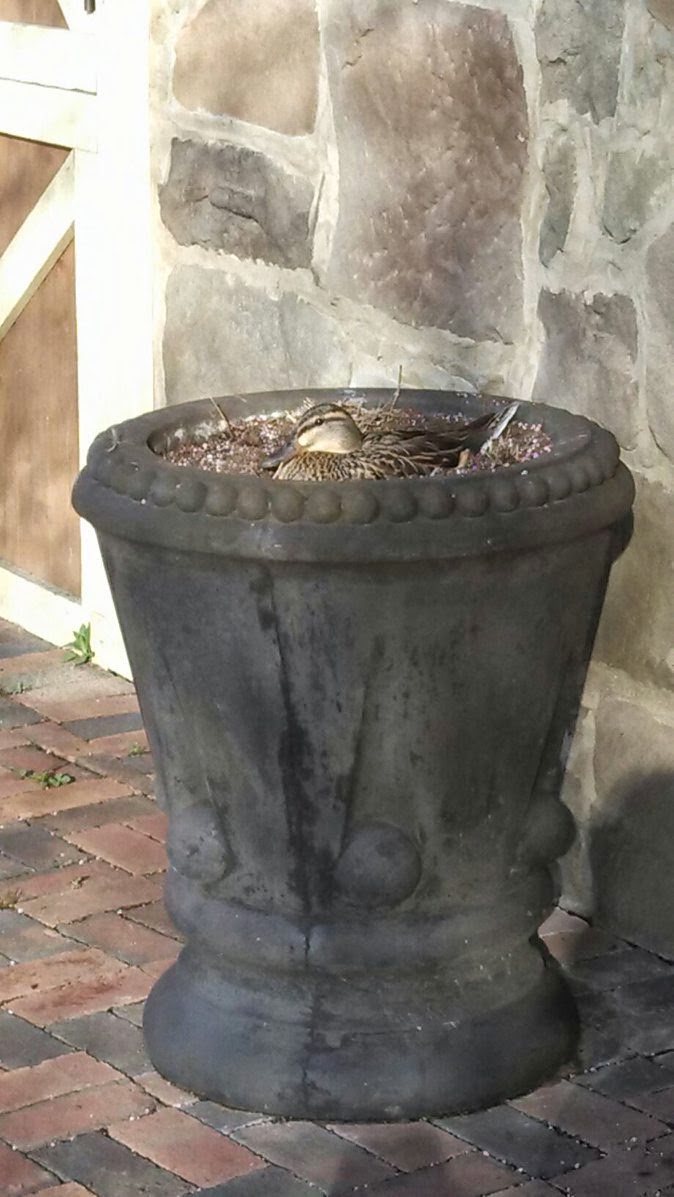
April 15: Vineyard ducks lay their first eggs
Female mallard tends her eggs in a vineyard flower pot.
April 17: Privet and multiflora rose leaf out in the hedge rows

April 18: Red maple bud burst

April 21: Weeping willow catkins

April 27: Bartlett pear blossoms in orchard 


April 29: First dogwood bracts


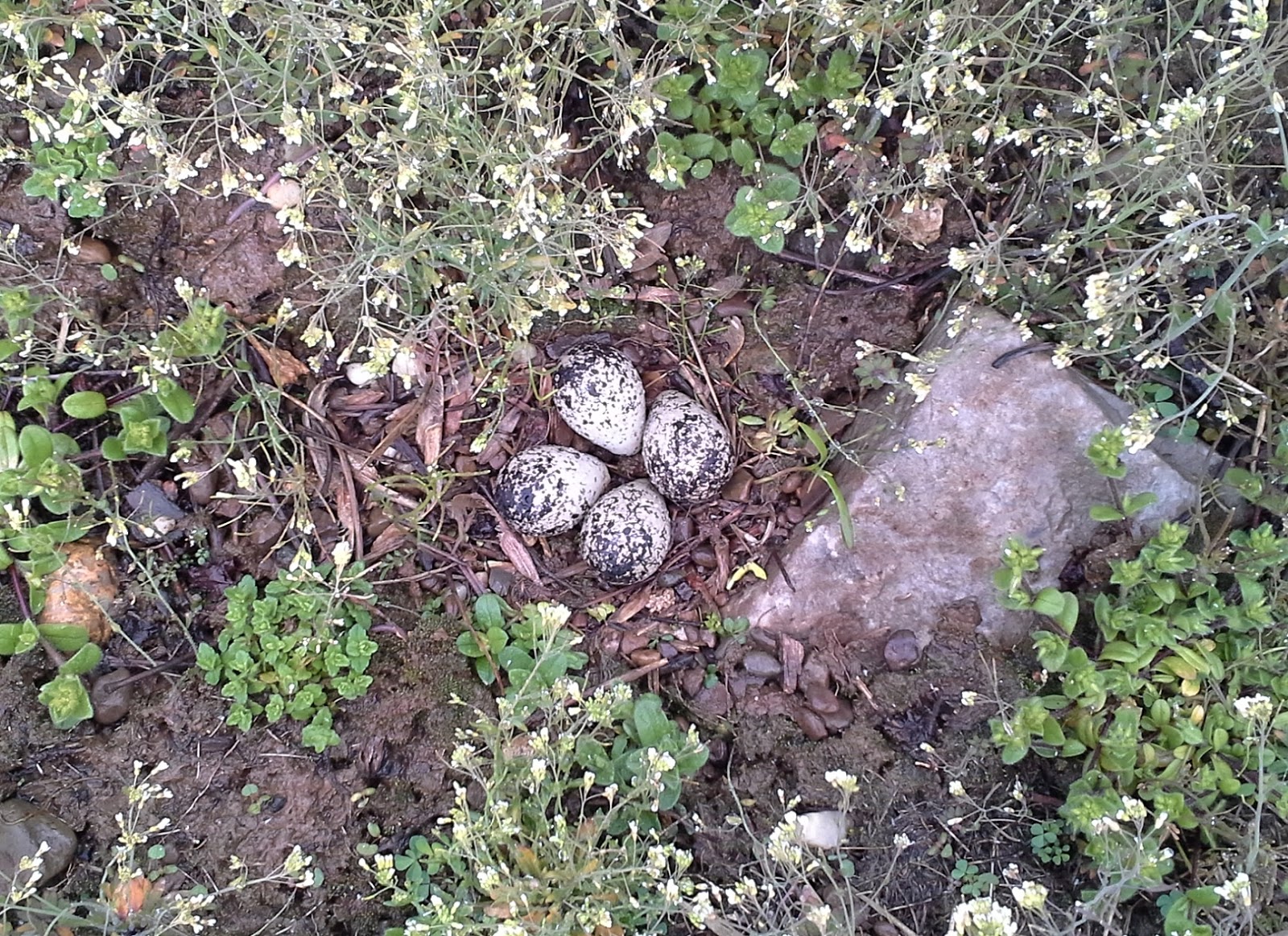
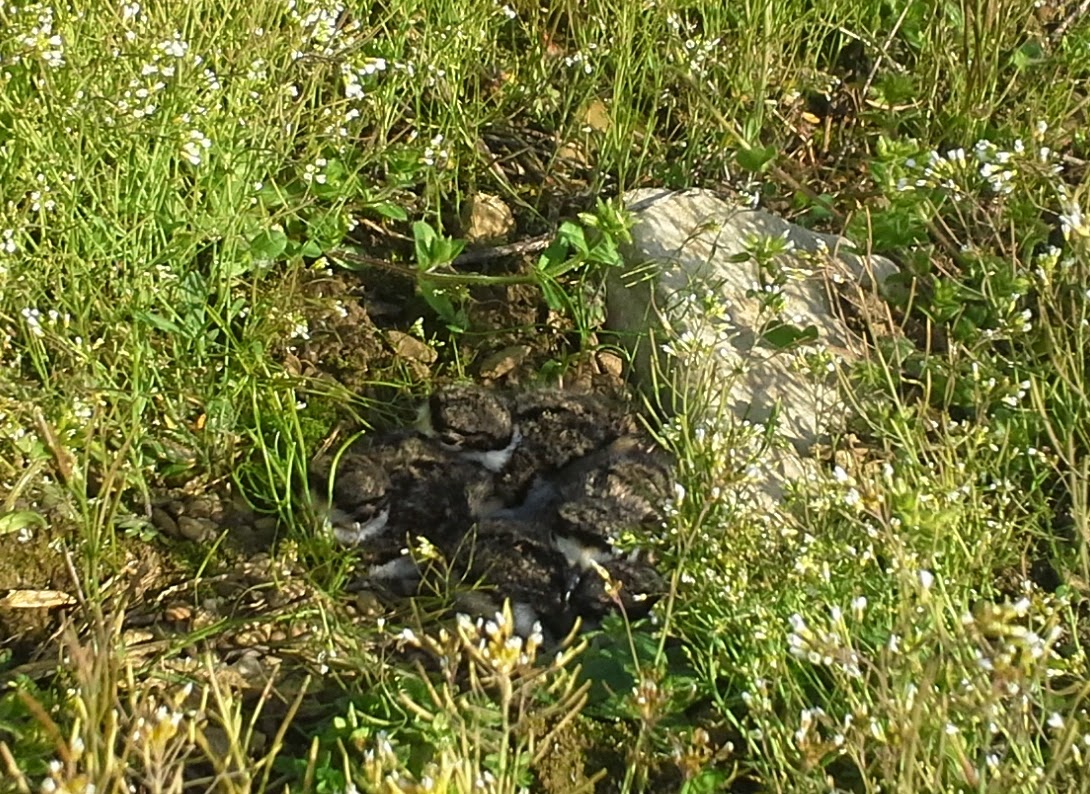
April 21: Vineyard killdeer lay eggs in North Vineyard


Speckled Killdeer eggs beneath the Frontenac Gris
May 1: Full dandelion bloom

May 2: Tulips at Carriage House

May 6: Red maple leaf out

May 5: Fiddleheads on Farmhouse ferns 


May 6: First apple blossoms

May 6: Dogtooth violets bloom

May 6: Vineyard Killdeer hatch


Very well camouflaged Killdeer hatchlings beneath the Frontenac Gris
May 7: Farmhouse lilacs bloom


May 8: Farmhouse crabapples bloom


May 8: Orchard in full bloom and first leaf out

May 9: Vineyard in full bud burst, with earliest varieties in leaf out

And so, we arrive at the culmination, which seems all the more epic after observing and noting each phenological marker as it occurred.

The vineyard bursts into leaf. 

Fifty one days after the vine sap first flowed. 

Thirty nine days after the skunk cabbages unfurled steamily from the swamp. 

Twenty six days after the forsythia blooms. 

Three days after the killdeer hatched.

Which brings us back to Mrs. Reynolds, that wise country schoolteacher, who burst into the classroom each morning with boundless enthusiasm, both for the work before us that day, and what was happening back home at the farm.

It only took me several decades, and almost four years on this farm, to begin to realize the depth of the wisdom she so effortlessly taught us:

Notice the things around you.
Make note of what is blooming each day.
Take care of other living things.
Anticipate what is about to happen.
Appreciate what is occurring right now.

I can't help but think that her infectious energy was absorbed in part from plunging herself so fully into the abundant life of the farm she so loved.

Vineyard phenology wasn't part of the curriculum Mrs. Reynolds was teaching in her Third Grade classroom so long ago. But lo and behold, it was a small part of the life wisdom she so graciously imparted.