Showing posts with label wildlife. Show all posts

Thursday, February 2, 2017

Midway

We have reached the midpoint of winter.

February 2nd, halfway between the winter and spring Equinox, is traditionally a day for farmers and those who tend the earth to pause and look forward.


In North America, ancient traditions have coalesced into Groundhog Day. Somewhat tongue-in-cheek, we look to our largest native North American rodent to prognosticate about what the future may hold.

Few animals in our region truly hibernate, even in the coldest of winters. There is a surprising amount of animal activity around us all winter long as we perform our winter vineyard tasks. In fact, in seasons where we have consistent snow on the ground, the volume and variety of tracks in the snow reminds us that open fields and woodland edges are heavily populated with a variety of creatures, most of which we never see.


And though our vineyard groundhogs have been with us all winter, we nevertheless have a little fun each season trudging out to their burrows, to see if one emerges to see his shadow on this particular day.

These latter days of winter are a fabulous time for shadows. Winter skies are often clear, ever increasing light comes down in a dramatic slant across an austere landscape.

The shadows of unpruned vineyard sections inscribe something that looks like a fantastical musical staff.


Our own trudgings are thrown in sharper relief, as are the slithers and scampers of vineyard denizens.


Trees cast long shadows across the lake.


The familiar profile of wild turkeys foraging crabapples in faint pre-dawn light is a familiar morning sight.

The rhythm of animal and plant life is fairly consistent across the seasons.

But of course, each winter can be very different than the last. The winter of 2014 and the winter of 2015 were especially memorable.

This year, snow has been rare.

By all accounts, this has been a very wet, and very warm winter: not ideal conditions for the grapevines, as it can stimulate them toward growth in the month when they should be most dormant.

There is a lot of winter still to be had.

For those interested in the prognostications of our resident Marmota monax: our vineyard groundhog did NOT see his shadow this morning.

A band of snow showers blotted the sky at sunrise, and briefly dressed the mud in a thin layer of flakes.


Which, the oldtimers contend, means warmer than usual conditions may well continue through these waning days of winter.

Our vineyard denizens will increase their activity as the days grow longer. As for our grapevine buds, we hope they remain fully asleep at least a few months longer.

Bud burst May 2015


Friday, March 20, 2015

St. Giuseppe


This year, like last, on the first day of spring a mushy late season snow fell in the pre-dawn hours.

Remnants of winter ice clung to the coldest corners of an otherwise warming lake.

In the vineyard our growing piles of winter vine prunings were blanketed once more in snow.

Marquette prunings in the North Vineyard
Despite the snow, however, the first indications of spring arrived in the vineyard just as they should:

For months buried in a thick snow pack, the turf in the vineyard rows is no longer ice crusted. It is now soft (and muddy) as the soil begins to thaw.

As as the soil thaws, capillary action in the vines pulls excess moisture from our old farm soil, a currently water-logged silty loam.

As the temperatures begin to rise, each of our thousands of vineyard pruning cuts begins to bleed: a good and welcome sign that the vines are alive and waking up after one of the coldest recorded winters in our region.

As the soil awakens, the plants will follow.

Down in the marsh, the (aptly named) skunk cabbages melt their own microclimate, sheaths of red mottled leaves arising steamily through the mire. They will bear early (and malodorous) flower, weeks before those plants on drier ground have even begun to show green.


And of course the vineyard animals are newly astir.

The killdeer have returned to chirp noisily through the vineyard rows, where they will build pebble nests under the vines.

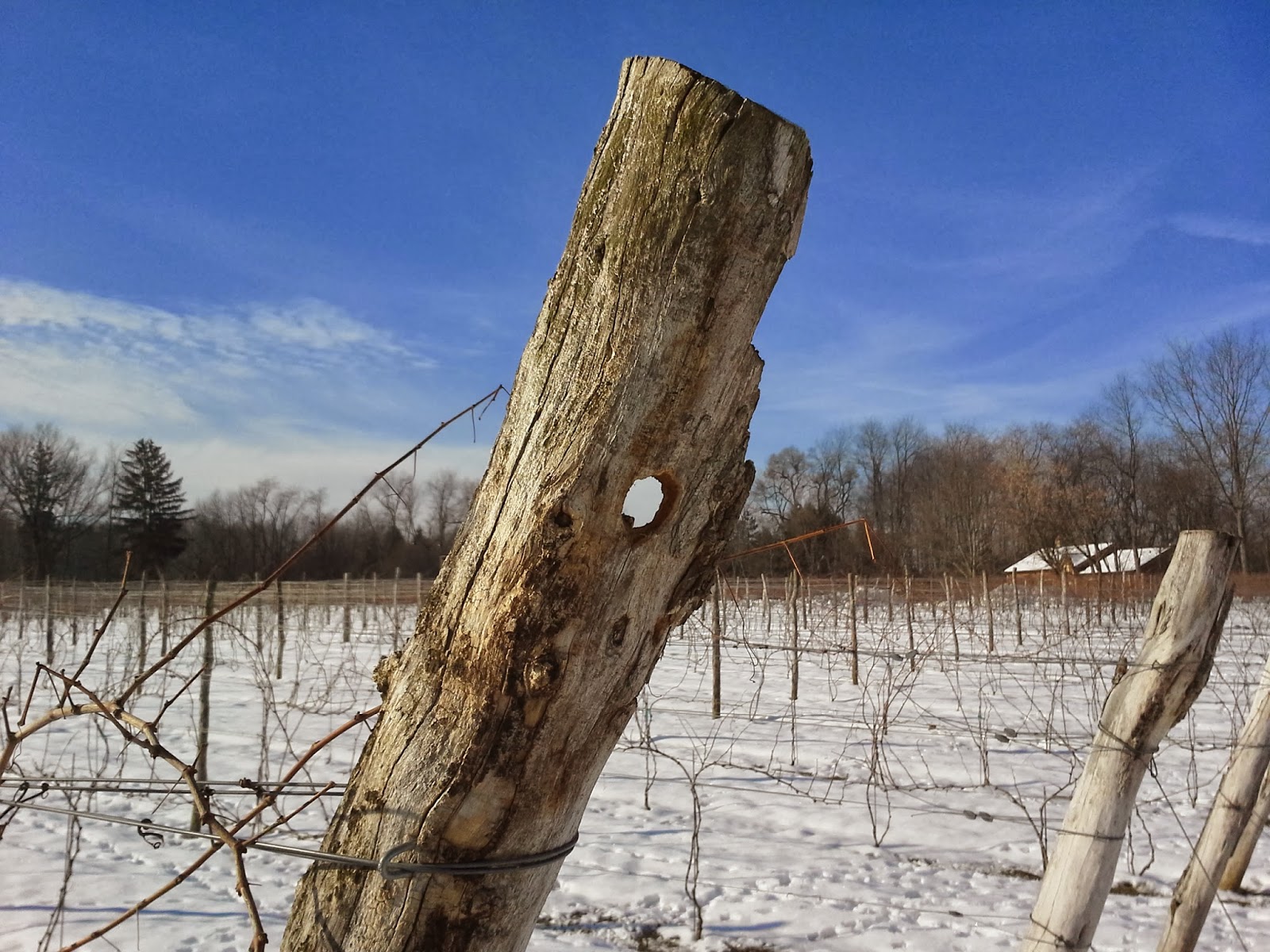
Bluebirds cheerfully negotiate for the choicest knotholes in the trellis poles.

And of course, seasonal drama unfolds amongst the waterfowl.

Giuseppe, our large male swan, hurumphed his way through the vineyard yesterday, in hot pursuit of an errant Canada goose.


Silly goose.

Anyone who's seen Giuseppe glide regally across our lake knows that this is undeniably Giuseppe's terrain.

You don't just show up with your bags packed, as the goose pair did, expecting to build a down feather nest under a pine tree.

If Giuseppe looked especially proud and puffed up yesterday, it might be because he knew it was St. Giuseppe Day.

Giuseppe and Gina
Falling on the eve of the Vernal Equinox, the Feast of San Giuseppe is traditionally a time to set an elaborate table in honor of St. Joseph, patron saint of children and of families.

And so, in the vineyard, it seems fitting on this day to pause for a few minutes, and watch resolute old Giuseppe defend his family home.

The first day of spring, under gray skies and just a little bit of snow.

The Vernal Equinox: a time to pause, and appreciate subtle spring awakenings.

Today, the daylight hours will be exactly as long as the night.

Tonight, the March New Moon will create an especially dark sky, perfect for stargazing.

An ideal time to pause, perhaps to enjoy a zeppole pastry topped with black cherries. (It's okay to take a brief respite from Lenten austerity, St. Joseph is also patron saint of pastry chefs).

A time to perhaps open a special bottle of wine, and savor the brief lull before the full flush of spring. (Which the blooming of the skunk cabbages tells us, is just around the corner.)


Friday, June 6, 2014

Bloom

Newly emerged Marquette leaves, weighted by dew at sunrise.

These abundant June mornings, we arrive at sunrise to a vineyard dripping with dew, and noisy with new life.

The vineyard is in bloom. 

On our historic farm property, this moment in the life of the vines coincides with a time when our diverse 55 acres of woodland, pasture, vineyard, orchard, and still &  flowing water greets us each day with new blossoms, freshly unfurled foliage, and, everywhere, creatures newly born and hatched.

I've never read a poetic ode to the glory of a vineyard in bloom.

The grape flowers themselves are green or a dull sulfurous yellow: exquisite in their own minuscule  perfection, but hardly showy enough to inspire a wandering bard to commit the sight to verse.

Inconspicuous Marquette bloom.
But let me attempt to paint a word picture of what a day in our vineyard looks like, in this short hopeful season when the grape vines bloom:

Our vineyard office sits atop a small swell of land, providing an opportune vantage to start our day. (I imagine the pioneer farmer who chose this site for his house had this exact morning vista in mind.)

We see the South Vineyard unfurling on a distant sunny slope.

In the foreground, steam rises from the spring-fed mill pond.

Our resident Great Blue Heron stands in majestic stillness on the barn stone shore line. Upon our approach, she silently swoops off with effortless grace.

A box turtle has slowly and methodically made her way from the distant lake to a bare patch of earth, where she deposits her eggs.

She blinks at us with startlingly pretty red-framed eyes.


Walking past the historic barn of virgin Ohio oak, we come upon the North Vineyard, and as we do so, Betty the brown duck toddles out from her nest under the hydrangeas, where she tends a clutch of eight eggs.

Arriving in the Marquette block of the vineyard, the sections we've worked through this week display neat walls of bright green foliage, contained between strands of galvanized wire.

Each of those thousands of rampant shoots was hand trained vertically to create this transitory scene of perfect order.

In a few more days, those newly trained rows, fed by abundant rain, lengthening days, and fertile loam, will produce another round of prodigious new growth, and we will start over once again from where we so recently began: restoring our version of Eden on what would prefer to be wilderness.

We walk down the rows, tucking some errant shoots that were either missed yesterday, or that grew overnight and flopped to the ground under the weight of a heavy morning dew.

Grape leaves that weeks ago were perhaps the size of a silver dollar are now bigger than my outstretched hand.


We scout for pests, mildew, mold, blight.

We check the rain gauge and the vineyard weather station.

Now, we enter the last rows of Marquette vines, the ones we have yet to tend in this round of training.

We are no longer in Eden, but somewhere far more primal. 

Thick blood-red shoots sprout from the base of the vines, and from all along the woody gnarled trunks. They seem to reach and grasp, bright red tendrils straining (menacingly?) for something to latch onto.

New green leaves unfurl above the trellis, dripping with dew, illuminated by the rising sun. 

We don't pause for too long, not for fear of the tendrils, but because this sunrise survey is just a short part of the work of our day.

Before moving along, however, we notice how incredibly LOUD the life in the vines can be in this season of bloom.

Killdeer hatched a few weeks ago when the grape buds first burst now scurry beneath the vineyard rows, trilling, singing, fanning their tails. 

On the lake shore, water fowl noisily squawk ancient rivalries, defending terrain, protecting their broods.

On the row ends, our newly-mounted bluebird houses are fully occupied.

A shiny indigo-breasted swallow emerges from one, splitting her attention between two ardent rivals.

Full Occupancy
Even the locust vineyard poles that support the galvanized wire and rampant vines sing: from knot hole nests within, the cheeping and chirping of newly hatched swallows.

Singing locust poles.
And so the work of the day commences.

This day when the vines blossom with insignificant flower, we hope to complete this section of Marquette, and make progress through the more orderly Frontenac Gris just beyond.

At the end of the day, we will pause at the end of our newly ordered rows, as errant red shoots we removed from craggy trunks shrivel on lush vineyard turf under a pleasant June sun.

We will pause for a moment, relishing the symmetry and order we have just imposed.

We will feel pride in the work accomplished in this bountiful June day.

And we will feel humbled, knowing that by Monday, it will be time to start over and do it all again.

Caught up in the new life unfolding so abundantly around us, we keep the perspective that it won't always be this way.

This season of bloom is the lush peak of the vineyard's yearly cycle.

Soon, the Solstice.

The days will imperceptibly shorten.

New growth will ebb ever so slightly.

Grape vines will put their energy into converting those insignificant dull blossoms into vibrant, sweet fruit.

Until then, we just try to keep up with the rampant vines, and enjoy the view along the way.

Fleeting perfection of order imposed.


Thursday, April 10, 2014

Quickening

Suddenly, with a flip of the calendar page, everything has changed amongst the birds.

Winter was a time to hunker down. 


Enormous flocks of Canada geese wintered with us, slumbering en masse at night on the iced lake, by day grubbing voraciously through a mantle of snow to pluck victuals from the turf. In their wake, a cacophony of churned earth and webbed foot prints.

Of a January vineyard morning, I would crunch through diamond-crusted snow before sunrise. 

At sunrise, coming to a small patch of open water, and the flotilla of ice where our swans slumber, I would feel like I'd entered a secret avian dream world: All is peace and crystalline beauty

The swans allowed a small trusted bevy of geese to sleep amongst them on their floating bed chamber, the rest banished to the lakeshore with the ducks. How very wise, I thought, to have these squawky sentries close at hand during the vulnerable silent hours.

During those peaceful winter mornings, I would observe that our ducks never sleep on the ice, except when there is a downy blanket of snow. On a snowy January morning, I arrived at sunrise to find our entire duck colony asleep on snowy ice. They rose with the sun, and begin chattering amongst themselves, waddling busily on the ice. (I think I could be content to watch ducks walk on ice all day.)

But change is afoot in the vineyard, the quickening of the year. 


Maple buds swelling against an April sky.

Skunk cabbage shoots rise steamily from the creekbed. 

Gliding raptors, aloft in a sky that is suddenly cerulean, dangle entrails of branches. 

On a rainy morning I notice our pair of mute swans display a newfound interest in golden willow branches that litter the lawn.

These quickening days, and an ever changing sky:

To the South, golden rays, impossible blue skies, fluffy white clouds.

Northward, impending wintry nebula, dark and foreboding. 

On many days snow flurries mixed with drizzle and warmth. 

This fleeting season, marked by the mysterious arrival of impossibly vivid ducks, with crimson necks. 

Raw, windswept March has just passed, when you would experience all of the seasons in just one day.

But gone now is March, and with it, the mysterious crimson ducks that visit each winter, then disappear as quickly as the whiteout flurries that sometimes materialized to displace a mid-afternoon sun.

The day the crimson ducks departed marked a noticeable change in avian behavior. 

All winter everyone got along, but the day the ducks left, our territorial male swan was suddenly bound and determined to keep a pair of Canada geese from nesting under a cherry tree. I could swear they are the exact same pair that tried to nest here last year, under a pine tree that is now gone. 

As the days lengthen, gone are the large colonies of ducks who gobbled at the swan chow bowl on frigid winter days.

Gone the riotous gaggle of geese who slumbered on the ice by night and rooted riotously through vineyard rows for daytime grub.

Gone the marauding robins who came out of nowhere to strip to bare twigs a crabapple tree which had somehow held its fruit through Christmas.

On these suddenly sunny April days, the birds have all paired off:

The swans daub a nest from mud and leaves and willow branches in a swampy finger of the lake.

An iridescent mallard and his handsome brown speckled bride toddle about the shrubbery at sunrise, looking for a place where in a few weeks she may deposit her eggs.

A pair of elegant mourning doves coo beside an old grape press in the rose bushes, seemingly grateful for the now bare earth on which to roost.

There is something to be said for days spent tending a vineyard. 

Even days that sometimes start with pelting sleet and a glaze of ice. 

And especially days during this magic season, when the year quickens perceptibly, and avian behavior takes a marked seasonal turn. 

An entire complex avian world goes about its seasons on the shore of this lake, and we feel privileged to be here to watch it unfold.

And throughout it all, in every season, a solitary Great Blue Heron swoops overhead, knowingly. (And sometimes, I kind of get the feeling that heron is orchestrating the whole thing.)


Skunk cabbage steamily rises.

Friday, February 14, 2014

Romance


Although an ancient and widely celebrated holiday, the origins of St. Valentine’s Day as a celebration of romance remain strangely murky.

And yet, going back to some of Europe’s oldest folklore, this has always been a day associated with, perhaps surprisingly, birds.

In Geoffrey Chaucer’s ‘The Parliament of Fowls’ (circa 1381), birds gather at the bower of “the noble goddess Nature” to settle love rivalries:

For this was on saint Valentinës day
When every fowl cometh there to chose his mate.

And so it went, through the centuries, February 14th was deemed the day the birds select their mates. (Which may work well in more temperate Europe, but particularly in a winter such as this, mid February is rarely the finest day to go a-courtin’ in our climate.)

Perhaps because vineyard work is largely solitary work (and grapevines are not particularly chatty) those of us who tend the vines often feel an affinity with the critters who share the landscape with us, and Gervasi Vineyard's diverse fifty-five acres of vineyard, woodland, fallow pasture, and wetlands support a particularly lively community of birds.


Knotty locust vineyard poles.
  • Barn swallows and bluebirds nest in the holes in our natural locust trellis poles, helping to control the insect population and keeping our grapevines healthy.
  • Chirpy killdeer build pebble nests on the open soil below the vines, depositing speckled eggs perfectly camouflaged amongst smooth glacial stones.
  • Eagles and hawks swoop majestically above our old crop fields, while sharp-kneed Great Blue Heron fish patiently in deep pools along the meandering creek that transects this, the last working farm in Canton, Ohio.
Among all of these creatures, however, it is clear that one pair rules the roost: Gina and Giuseppe, our regal pair of white mute swans.


During winter months you might find them bedded down on snow nests they build on ice patches on the lake.

If we ever get some warm days this winter, you will find Giuseppe diving down to the deepest muck of the lake, to begin daubing a leaf, mud, and willow branch throne for his lovely bride, Gina.

It is during the summer months, however, that Gina and Giuseppe are in their element. On certain crystalline Tuscan afternoons, when the afternoon light is perfect, Gina and Giuseppe glide in to view. They pirouette, dive and splash extravagantly, and, on occasion, touch bills, elegant necks joined together as a heart, perfectly reflected in still blue water.

Being mute swans, of course they cannot speak, but we like to think this is their way of saying Benvenuto!

Because mute swans mate for life, Giuseppe does not need to enact the ancient folkloric ritual of choosing a new mate each February 14th.


But if you are strolling our grounds this snowy Valentine’s Day, or any day of the year, and you happen to encounter our regal pair touching bills to form a heart with their elegant necks, consider it your personal welcome to Gervasi Vineyard, and the romanza of this place.

Monday, February 3, 2014

Shadows

February 2nd has come and gone, which means the sun has just passed the halfway mark on in its journey from the winter solstice to the spring equinox.

The days grow perceptibly longer.

Which also means North America's largest rodent has just had his day in the sun (or shadows, as the case may be).

Marmota monax, the common North American woodchuck.
The famous Pennsylvania rodent has been roused by a gentleman in a top hat from his rather well-appointed den.

Here at the vineyard, Bucky, our resident Marmota monax has yet to stir.

His rocky den, on a sunny vineyard slope under a Petite Pearl grape vine, is still blanketed under an undisturbed snow:


Of course, this may or may not be the den where he is sleeping, as groundhogs are known to construct multiple chambers, the winter quarters often more secluded than the summer lodgings.

But this is where he was last seen, on one of those golden autumn afternoons, when the sweet gum trees blazed orange along the creek bed, and the enormous cottonwood by the bridge glowed amber.

Given that we are coming off one of the coldest Januaries in memory, and the East Coast is forecast to be blasted again this week, our resident rodent's extended slumber is not unexpected, nor does his Pennsylvania cousin's notoriously inaccurate prediction of an extended winter seem far off this time around.

As we trudge through the frozen vineyard rows doing winter pruning, we perhaps feel a kinship with those agrarian immigrants from long ago, who brought from Europe their ancient seasonal folklore, substituting our portly North American woodchuck for the black and white striped badger who was the European prognosticator of Spring.

This midpoint of winter, we are desperate for any sign of reassurance, so it is natural to look toward our familiar vineyard denizens for impending change.

Our sharp-kneed Blue Heron, who lives in the reeds, has been a bit more visible of late, swooping majestically over the lake, on warm days when the sun opens up some water.

Footprints reveal Mr. Muskrat has made a few furtive forays from his willow tree den, not making it far before circling back home.

I will continue to be on the lookout for Bucky, our somewhat reticent vineyard woodchuck, who in the summer perches on his stubby hind legs as a silent sentinel in the South Vineyard, until he sees me and lumbers back to his rocky warren at a surprisingly fast clip, for a gentleman of such ample proportion.

Until Bucky rouses himself, it is to our swans I will look as true harbingers of spring.


These days at sunrise I arrive to find Gina and Giuseppe hunkered down on snow nests atop an icy lake.

But some day soon, around the time newly amorous skunks perfume the sunrise, I will arrive to find Gina and Giuseppe swimming along the shore, with a new found interest in twigs and branches.

A flurry of activity will ensue, and once Gina is enshrined atop her floating twiggy throne, we will know it won't be long until the vineyard buds break.

Until then, Bucky continues to slumber.

Sleeping off, I imagine, a late autumn indulgence of overripe grapes.