Friday, February 14, 2014

Romance


Although an ancient and widely celebrated holiday, the origins of St. Valentine’s Day as a celebration of romance remain strangely murky.

And yet, going back to some of Europe’s oldest folklore, this has always been a day associated with, perhaps surprisingly, birds.

In Geoffrey Chaucer’s ‘The Parliament of Fowls’ (circa 1381), birds gather at the bower of “the noble goddess Nature” to settle love rivalries:

For this was on saint Valentinës day
When every fowl cometh there to chose his mate.

And so it went, through the centuries, February 14th was deemed the day the birds select their mates. (Which may work well in more temperate Europe, but particularly in a winter such as this, mid February is rarely the finest day to go a-courtin’ in our climate.)

Perhaps because vineyard work is largely solitary work (and grapevines are not particularly chatty) those of us who tend the vines often feel an affinity with the critters who share the landscape with us, and Gervasi Vineyard's diverse fifty-five acres of vineyard, woodland, fallow pasture, and wetlands support a particularly lively community of birds.
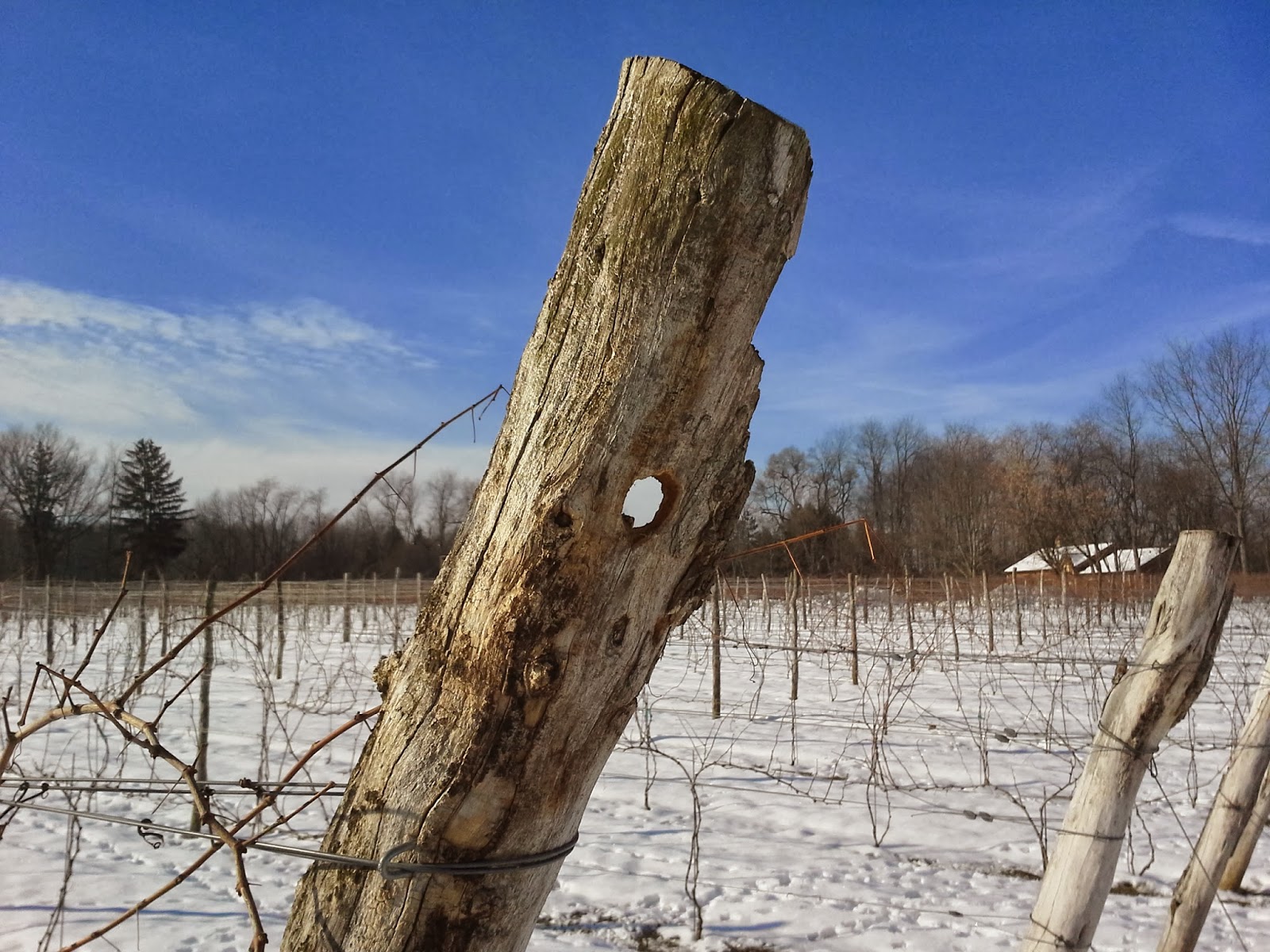

Knotty locust vineyard poles.
  • Barn swallows and bluebirds nest in the holes in our natural locust trellis poles, helping to control the insect population and keeping our grapevines healthy.
  • Chirpy killdeer build pebble nests on the open soil below the vines, depositing speckled eggs perfectly camouflaged amongst smooth glacial stones.
  • Eagles and hawks swoop majestically above our old crop fields, while sharp-kneed Great Blue Heron fish patiently in deep pools along the meandering creek that transects this, the last working farm in Canton, Ohio.
Among all of these creatures, however, it is clear that one pair rules the roost: Gina and Giuseppe, our regal pair of white mute swans.


During winter months you might find them bedded down on snow nests they build on ice patches on the lake.

If we ever get some warm days this winter, you will find Giuseppe diving down to the deepest muck of the lake, to begin daubing a leaf, mud, and willow branch throne for his lovely bride, Gina.

It is during the summer months, however, that Gina and Giuseppe are in their element. On certain crystalline Tuscan afternoons, when the afternoon light is perfect, Gina and Giuseppe glide in to view. They pirouette, dive and splash extravagantly, and, on occasion, touch bills, elegant necks joined together as a heart, perfectly reflected in still blue water.

Being mute swans, of course they cannot speak, but we like to think this is their way of saying Benvenuto!

Because mute swans mate for life, Giuseppe does not need to enact the ancient folkloric ritual of choosing a new mate each February 14th.


But if you are strolling our grounds this snowy Valentine’s Day, or any day of the year, and you happen to encounter our regal pair touching bills to form a heart with their elegant necks, consider it your personal welcome to Gervasi Vineyard, and the romanza of this place.

Monday, February 3, 2014

Shadows

February 2nd has come and gone, which means the sun has just passed the halfway mark on in its journey from the winter solstice to the spring equinox.

The days grow perceptibly longer.

Which also means North America's largest rodent has just had his day in the sun (or shadows, as the case may be).

Marmota monax, the common North American woodchuck.
The famous Pennsylvania rodent has been roused by a gentleman in a top hat from his rather well-appointed den.

Here at the vineyard, Bucky, our resident Marmota monax has yet to stir.

His rocky den, on a sunny vineyard slope under a Petite Pearl grape vine, is still blanketed under an undisturbed snow:


Of course, this may or may not be the den where he is sleeping, as groundhogs are known to construct multiple chambers, the winter quarters often more secluded than the summer lodgings.

But this is where he was last seen, on one of those golden autumn afternoons, when the sweet gum trees blazed orange along the creek bed, and the enormous cottonwood by the bridge glowed amber.

Given that we are coming off one of the coldest Januaries in memory, and the East Coast is forecast to be blasted again this week, our resident rodent's extended slumber is not unexpected, nor does his Pennsylvania cousin's notoriously inaccurate prediction of an extended winter seem far off this time around.

As we trudge through the frozen vineyard rows doing winter pruning, we perhaps feel a kinship with those agrarian immigrants from long ago, who brought from Europe their ancient seasonal folklore, substituting our portly North American woodchuck for the black and white striped badger who was the European prognosticator of Spring.

This midpoint of winter, we are desperate for any sign of reassurance, so it is natural to look toward our familiar vineyard denizens for impending change.

Our sharp-kneed Blue Heron, who lives in the reeds, has been a bit more visible of late, swooping majestically over the lake, on warm days when the sun opens up some water.

Footprints reveal Mr. Muskrat has made a few furtive forays from his willow tree den, not making it far before circling back home.

I will continue to be on the lookout for Bucky, our somewhat reticent vineyard woodchuck, who in the summer perches on his stubby hind legs as a silent sentinel in the South Vineyard, until he sees me and lumbers back to his rocky warren at a surprisingly fast clip, for a gentleman of such ample proportion.

Until Bucky rouses himself, it is to our swans I will look as true harbingers of spring.


These days at sunrise I arrive to find Gina and Giuseppe hunkered down on snow nests atop an icy lake.

But some day soon, around the time newly amorous skunks perfume the sunrise, I will arrive to find Gina and Giuseppe swimming along the shore, with a new found interest in twigs and branches.

A flurry of activity will ensue, and once Gina is enshrined atop her floating twiggy throne, we will know it won't be long until the vineyard buds break.

Until then, Bucky continues to slumber.

Sleeping off, I imagine, a late autumn indulgence of overripe grapes.

Wednesday, January 29, 2014

Janus

Snow Rollers in the North Vineyard
A new year dawned in the vineyard with a bracing seasonal chill, with just enough flurries to flock the landscape.

Ever since, January hasn't been nearly so benign. The first week sent the meteorologists scrambling to the far recesses of their textbooks, to come up with a name for the sudden and drastic temperature dip. Suddenly "Polar Vortex" was on the tip of all of our tongues.

Aptly named winter storm Janus followed not long after, blanketing much of the country under substantial snow accumulation, as temperatures plunged yet again.

This week a second Vortex descended, and despite our overnight temperatures plunging to -14 degrees, a stroll through our acres of grapes reveals a world of startling beauty, with just a little bit of mystery.

Frigid January sun casts blue shadows on our thick blanket of crystal-flecked snow. It is remarkable how subtle shifts in light and temperature can alter the laws of optics. Snow that days ago seemed gray or blinding undifferentiated white, is today crystalline and sparkling, with blue shadows and highlights.

Trellis poles and Marquette vines cast blue shadows.
Our familiar vineyard denizens leave their usual tracks.

The fawn family transects the South Vineyard along their preferred route. Our Canada geese have departed, perhaps for warmer climes, but not before leaving behind a complicated choreography of webbed footprints in the snow. Mr. Muskrat seems to have roused himself from his lodgings beneath a particularly gnarled willow. Apparently he found conditions not to his liking, and circled back from whence he came, not even making it so far as the lake.

His cousin, Mr. Groundhog, has apparently yet to stir from his rocky warren beneath one of our Petite Pearl grapevines. His biggest day of the year is just days away, and apparently he is still sleeping off his autumn grape feast.

Other markings are more mysterious: various prints and traces that start and end abruptly, deep snow and high winds obscuring useful identifying shapes.

These snowy perambulations are not just a pleasant nature walk.

We are out gathering grape canes, a random sample from eight separate vineyard blocks spread across five acres. These we will take inside and cut open the dormant buds, to examine the effects of extreme cold on next year's crop. So far our very hardy varieties are faring well, but each new drastic temperature plunge sends us back out to gather more samples.

Stark contours of a pruned vine.
Along the North Vineyard, windswept terrain slopes down toward the lake, and here we encounter fantastical formations: snow rollers, formed by the unique weather patterns of the past few days.

It is eerie to suddenly encounter them, because everywhere else the snow is so even and still. But here unseen forces have rolled the snow up, into formations resembling millstones or Swiss rolls or magic winter carpets.

Our vineyard remote data logger tells us that Monday morning at 2:42 AM we recorded a balmy high of 38 degrees. Fourteen hours later, just before Tuesday's dawn, we recorded our low, -14 F.

Somewhere along the way, just enough ice formed a crust on top of the snow, so that any softer snow that blew across it did not stick, but continued to roll, rolling along with other soft particles until they adhered themselves into a formation, that subsequent lower temperatures froze into place.

Another unusual January occurrence in a most peculiar month.

Fantastical formations
The ancients named this month after Janus, a god with two faces, symbolizing beginnings and ends. He ruled over gates and doorways, passages, endings and time.

With just a few days left, what further surprises, and what little mysteries, might January bring to us yet?

Friday, January 17, 2014

Balance

Petite Pearl grapes in the South Vineyard, August 2013

These deep days of winter, with the vineyard blanketed in snow, we think ahead to the warmest days of summer.

We contemplate the fruit these now bare twigs will bear.

The foliage is long gone. A few shriveled grape clusters cling through wintry gusts. Sometimes it is hard to remember the verdant abundance of a few months ago.

But summon those summery scenes we must, for decisions we make now will affect the yield of September.

In winter we prune.

We cut the prolific growth of last summer back to a few stubby spurs, short woody stubs sprouting from (increasingly) gnarled trunks below.

We place last summer’s canes—brittle tawny twigs, still kiwi-green in the center—in yellow plastic harvest totes that in the fall held sweet fruit. We weigh them.

Pruned Marquette canes in a harvest tote, to be weighed.
There is a formula for balanced pruning.

The weight of the canes removed from each vine gives us a sense of that plant’s vigor. The vigor of last year’s growth lets us know how much energy is stored in those bare trunks and hidden roots to feed next year’s crop. The formula lets us know how long to leave the spurs on top of the permanent trunk.

Two, three, or four buds per spur? The weight of the prunings and the grape varietal they come from will help us to know.

The goal is balance: curbing the vine’s prolific tendencies. Producing the best yield, without stressing the plant’s permanent health with too much fruit.

Balance: just enough vigor, but not too much.

Balance: visualizing prolific growth that will emerge from the buds that remain, projecting how many buds might be lost to late season frost.

Contemplating autumn’s sunny abundance, on a frigid January afternoon in a snow capped vineyard: its own form of balance, I suppose.

Tuesday, January 7, 2014

Vortex


Today's high temperature, 1:00 PM.

The "polar vortex" descended on North America, and the news media is abuzz.

Dire warnings of frozen pipes, frost quakes and frost bite.

But what about the vines?

For the most part, our grape vines don't seem to mind too much (yet.)

They are at their full dormant stage at this point in the winter, the time they are best suited to endure such conditions. In fact, our Minnesota and upstate-New York bred plants wouldn't mind terribly if it dipped double digits below zero. (The coldest reading our vineyard thermometer recorded last night was a relatively balmy -4 F.)

"Wind Chill" is a warm blooded mammal concern, and our vines are unconcerned with these dramatic numbers the weather media trumpets. (Even our swans seem to have missed the Polar Vortex warnings, as they swim contentedly in a circle of open water on an otherwise frozen lake, water kept open by current created by the paddling of their enormous webbed feet.)

For now it is calm and quiet in the vineyard. The snow crunches crisply underfoot.

Although, if you stand around long enough, you will hear some disconcerting cracks ("frost quake" in the locust vineyard poles) and eerie squeals (galvanized trellis wires tensioning and vibrating as they contract.)

Friday, December 13, 2013

Clarity


One of the remarkable things about tending these acres in all season and conditions, is getting to experience the subtleties of each season.

We often perceive winter in Northeastern Ohio as an undifferentiated blur of salt-stained gray.

But a shift in the clouds, however fleeting, can reveal startling colors and clarity, especially on a single digit December afternoon, when ice crusted snow sparkles beneath a startling clear blue sky, and the competing textures of flowing water and solid ice create a stunning backdrop for our avian vineyard friends.

Friday, November 29, 2013

The Vineyard Sleeps

For several months we have had occasional hoarfrost in the morning, crystalline frost on dying foliage, a smattering of flurries and squalls.


But one day the first heavy snow of the season arrives, and stays, and the vineyard finally slumbers.

There is something remarkably peaceful about the first snowy vineyard sunrise of the season. The snow muffles all sound, the ground is covered, the lake partially frozen.

That is our signal that the post-harvest work of the vineyard is mostly finished. What did not get accomplished will wait until another season, for these are the days when we start to look ahead.

In a few short weeks the crucial work of pruning begins, when last season's growth is removed and we choose how many buds to leave on woody spurs. Latent in each bud, is next years's life: rampant shoots, lush foliage, delectable fruit, for these few months slumbering in a quiet, snowy vineyard.