Tuesday, August 19, 2014

Tonnage

A dewy Arandell cluster at veraison, culled from the vines.
Vineyard work is often solitary work. But that's not to say those of us who tend the vines don't enjoy visitors in the vineyard rows.

We absolutely love it. 

Sure, these 4,000+ grape vines and this bevy of swans can be amiable companions. But conversationalists, they are not.


This time of year, the most frequent question we get from guests who stroll into the rows: What are you doing with all of those grapes you are picking? 

Baskets and bins of them. Sometime a full Bobcat load.


No, we are not harvesting yet.

We are culling imperfect fruit from the vines in anticipation of harvest.

Since January, every decision we make, from dormant pruning to bud adjustment to shoot positioning to cane and cluster thinning, is aimed at reducing the size (and increasing the quality) of the eventual wine grape crop.

A bushel of Petite Pearl 

Right now we feel pretty good about the amount of fruit our vines bear. But from now to harvest, we will continue to pass through as time allows to cull under ripe, overripe, crowded, and damaged clusters.

Statistically, the amount of fruit we remove isn't huge based on the overall vineyard crop.

But with thousands of vines, even a few clusters pulled from each one, eventually adds up to TONS.

And so the work of the vineyard continues.

A productive vineyard day is a messy vineyard day.

In our wake, depending on the season, we leave piles of pruned canes, carpets of trimmed shoots, baskets of culled fruit.

The never ending attempt to contain the bounty of nature.

All of the extra tonnage, returned to the earth, composted and eventually feeding  another cycle of growth.


The second most common question we get from vineyard visitors: This vineyard is immaculate!

Well, perhaps not at the peak of our work day.

We always have to leave a little time at the end, to remove the tonnage of detritus produced.


If we do our job right, you'll never now we were here.

No one, except the swans, and the grapes.

And they usually keep all of our secrets.


Thursday, August 14, 2014

Countdown

It's hard to remember an August quite like this.


The mornings greet us in the vineyard with dew kissed grape clusters, and overflowing rain gauges (four plus inches on a recent torrential night.)

Breezy afternoons where the thermometer hovers at 70.

Rain gear and jackets that normally wouldn't see the light of day until October are summoned from musty storage.

And so the pleasant work of Veraison, the season when the vines ripen their fruit, carries on in the vineyard.

Our six varietals, August 14, beginning to show their harvest hues.
Imperfect clusters are culled from the vines.

Clusters are gathered, weighed, tasted, and chemically analyzed to track ripening.

Bird netting is installed.

Normally in this season, our concerns are staying hydrated and watching for sun stroke, as we race the clock  to fully dress the vines for harvest.

This year we have to remember to pack an extra jacket, and be on the look out for mold and mildew on the damp vines.

So while it makes a pleasant work day for the vineyard workers, the vines themselves would prefer it much hotter and drier.

If our previous harvest seasons in Canton, Ohio have taught us anything, it is to expect the unexpected:

And so it is: another unusual season among the vines.

But, what a beautiful season it has been.

Each day forward on the countdown to harvest, we will be posting here a picture or an observation  from the vines.

Labor that began among snow rollers in a Vortex-frozen January vineyard, continues its steady march through an unseasonably cool August.

Anything can yet happen:

Stay tuned, and watch it unfold.

Bushels of imperfect fruit, culled from the vines.


Friday, July 25, 2014

Change

For months in the vineyard now we've been surrounded by walls of solid green.

Tiny buds that seemed so vulnerable on those startlingly cold May mornings have since unleashed a torrent of growth.

We've trained, nurtured, and positioned those individual shoots.

Up through the trellis wires.

Forcing rampant nature into an orderly form it would rather not take. We've had a lot of intimate contact with acres of nothing but green.

So needless to say, something that is NOT green catches your eye.

Marquette cluster in the North Vineyard, July 21

As it did a few days ago.

The first few berries I assumed were wasp-stung or perhaps bruised by the tractor.

Then I'd see another.

And another.

From sour apple green to a slightly bruised olive, until finally pink, and ultimately purple.

So it wasn't an injury or an outbreak of disease in the vineyard, but rather the season unfolding exactly as it should:

The second-to-last week of July, amidst a rare stretch of startlingly pleasant 75-degree days, we have arrived at the season of Veraison.


Veraison is when the grape vines shift their energy from vegetative growth, to the ripening of the fruit.

The outward clue to this internal shift is the sudden arrival of points of color amid all of the green.

One by one, the berries (as each individual grape on the bunch is known) turn.


For a few days, which some call the party balloon phase, the individual berries on each cluster will vary: Greens and pinks and reds and purples happily co-mingle on all the same bunch.

Eventually, they will stabilize to the final varietal hue.


In the case of our our vineyard, our six varietals will produce clusters that will range from amber (Vignoles) to apricot (Aromella) to to bronze (Frontenac Gris) to dark purple (Arandell and Petite Pearl) to blue-black (Marquette).

Until these jewel tones settle into their final ripe color, we will enjoy the variety, and a palette that changes by the hour, with each subtle shift of the afternoon rays, with each berry that darkens and sweetens, exactly on cue.

Blackberries along the South Vineyard fence row.

This year, veraison struck the same day the wild brambles along the back fence row yielded their first glistening fruit, the same day the apples in the orchard acquired their first blush of red, the same day the poke weed along the gravel lane began to drip fountains of purple fruit.

The shortening of the days.

The approach of autumn.

All around us, the plants are responding, coloring the landscape, enticing the birds.

It's a beautiful scene, but one in which we can't linger.

Leaves must be pulled from the ripening clusters, exposing them to even light to ripen the fruit.

Vines must be trained.

Bird netting unfurled, hopefully in advance of ravenous migratory hordes.

It's the kind of day you pause at the end of, look down the neat green row you've just worked through, admiring the new hues, ignoring the rampant untamed growth (just for the moment) that lies ahead.

Our varietals in August (clockwise from top): Marquette, Frontenac Gris, Arandell, Petite Pearl, Aromella. Center: Vignoles.


Friday, June 6, 2014

Bloom

Newly emerged Marquette leaves, weighted by dew at sunrise.

These abundant June mornings, we arrive at sunrise to a vineyard dripping with dew, and noisy with new life.

The vineyard is in bloom. 

On our historic farm property, this moment in the life of the vines coincides with a time when our diverse 55 acres of woodland, pasture, vineyard, orchard, and still &  flowing water greets us each day with new blossoms, freshly unfurled foliage, and, everywhere, creatures newly born and hatched.

I've never read a poetic ode to the glory of a vineyard in bloom.

The grape flowers themselves are green or a dull sulfurous yellow: exquisite in their own minuscule  perfection, but hardly showy enough to inspire a wandering bard to commit the sight to verse.

Inconspicuous Marquette bloom.
But let me attempt to paint a word picture of what a day in our vineyard looks like, in this short hopeful season when the grape vines bloom:

Our vineyard office sits atop a small swell of land, providing an opportune vantage to start our day. (I imagine the pioneer farmer who chose this site for his house had this exact morning vista in mind.)

We see the South Vineyard unfurling on a distant sunny slope.

In the foreground, steam rises from the spring-fed mill pond.

Our resident Great Blue Heron stands in majestic stillness on the barn stone shore line. Upon our approach, she silently swoops off with effortless grace.

A box turtle has slowly and methodically made her way from the distant lake to a bare patch of earth, where she deposits her eggs.

She blinks at us with startlingly pretty red-framed eyes.


Walking past the historic barn of virgin Ohio oak, we come upon the North Vineyard, and as we do so, Betty the brown duck toddles out from her nest under the hydrangeas, where she tends a clutch of eight eggs.

Arriving in the Marquette block of the vineyard, the sections we've worked through this week display neat walls of bright green foliage, contained between strands of galvanized wire.

Each of those thousands of rampant shoots was hand trained vertically to create this transitory scene of perfect order.

In a few more days, those newly trained rows, fed by abundant rain, lengthening days, and fertile loam, will produce another round of prodigious new growth, and we will start over once again from where we so recently began: restoring our version of Eden on what would prefer to be wilderness.

We walk down the rows, tucking some errant shoots that were either missed yesterday, or that grew overnight and flopped to the ground under the weight of a heavy morning dew.

Grape leaves that weeks ago were perhaps the size of a silver dollar are now bigger than my outstretched hand.


We scout for pests, mildew, mold, blight.

We check the rain gauge and the vineyard weather station.

Now, we enter the last rows of Marquette vines, the ones we have yet to tend in this round of training.

We are no longer in Eden, but somewhere far more primal. 

Thick blood-red shoots sprout from the base of the vines, and from all along the woody gnarled trunks. They seem to reach and grasp, bright red tendrils straining (menacingly?) for something to latch onto.

New green leaves unfurl above the trellis, dripping with dew, illuminated by the rising sun. 

We don't pause for too long, not for fear of the tendrils, but because this sunrise survey is just a short part of the work of our day.

Before moving along, however, we notice how incredibly LOUD the life in the vines can be in this season of bloom.

Killdeer hatched a few weeks ago when the grape buds first burst now scurry beneath the vineyard rows, trilling, singing, fanning their tails. 

On the lake shore, water fowl noisily squawk ancient rivalries, defending terrain, protecting their broods.

On the row ends, our newly-mounted bluebird houses are fully occupied.

A shiny indigo-breasted swallow emerges from one, splitting her attention between two ardent rivals.

Full Occupancy
Even the locust vineyard poles that support the galvanized wire and rampant vines sing: from knot hole nests within, the cheeping and chirping of newly hatched swallows.

Singing locust poles.
And so the work of the day commences.

This day when the vines blossom with insignificant flower, we hope to complete this section of Marquette, and make progress through the more orderly Frontenac Gris just beyond.

At the end of the day, we will pause at the end of our newly ordered rows, as errant red shoots we removed from craggy trunks shrivel on lush vineyard turf under a pleasant June sun.

We will pause for a moment, relishing the symmetry and order we have just imposed.

We will feel pride in the work accomplished in this bountiful June day.

And we will feel humbled, knowing that by Monday, it will be time to start over and do it all again.

Caught up in the new life unfolding so abundantly around us, we keep the perspective that it won't always be this way.

This season of bloom is the lush peak of the vineyard's yearly cycle.

Soon, the Solstice.

The days will imperceptibly shorten.

New growth will ebb ever so slightly.

Grape vines will put their energy into converting those insignificant dull blossoms into vibrant, sweet fruit.

Until then, we just try to keep up with the rampant vines, and enjoy the view along the way.

Fleeting perfection of order imposed.


Friday, May 9, 2014

Burst!

May 6, 2014: First apple blossoms in the orchard, three days before vineyard bud burst.


I try to keep this blog close to target, talking about grapes and viticulture (with occasional diversions into swan husbandry and the way snow looks in different permutations of winter sky.)

So bear with me a bit today if it seems like I'm rambling...but it all circles back to what is going on in the vineyard right now, the season of the vineyard with the appropriately explosive name: Bud Burst!

One of the wisest women I ever knew, was Mrs. Jane Reynolds.

She was my third grade teacher at Gordon M. DeWitt Elementary School in Cuyahoga Falls, Ohio.

DeWitt School faculty, 1974. Mrs. Reynolds, second from right, front row.
She passed away several weeks ago at the age of 97, after a long and purposeful life.

Although my calculations may be way off (since I was barely four feet tall at the time) I am pretty sure she wasn't much taller than 5'1", and what a dynamo of energy she was.

(Tongues still wag over an mid-1970's last-week-of-school Field Day, where she jumped into the Tug-Of-War, handing decisive victory to her underdog 3-1 grade class, over Mrs. Villemein's much favored 3-2.)

What I remember about her was not just that she was a fantastic teacher, and that she did all the things the other good teachers did, but that she somehow managed to squeeze into each day, and each class, even more than everyone else did.
Above all, I remember her boundless energy.

In addition to her full-time teaching job, she and her husband, Mr. R. O. Reynolds, the retired band director at the high school, had recently moved to and were restoring her ancestral family farm.

(I learned from her obituary that her great-great grandfather had walked from New Hampshire to Ohio to stake a claim on the Western Reserve, and that was the farm she and her husband were restoring.)

Whatever was going on on the farm in a particular season, she would bound into the classroom with examples to show off: The first puffy pussy willow buds of the season. The first drips from the maple buckets during sugaring days. Branches of crabapple in full bloom. The season's first chirpy fluff chicks.

So, for several weeks now, I have been hauling my vase of grape canes around, showing off to anyone who will listen the magic of the buds unfurling, the abundant life inside each inauspicious hard scaly brown bud, which needs just warmth, sunshine and water to unleash abundant green life stored within.

And now that season we had been forcing indoors under hothouse conditions is happening spontaneously in the vineyard acres around us.

May 9, 2014: Ladies and gentlemen, we have achieved BUD BURST.
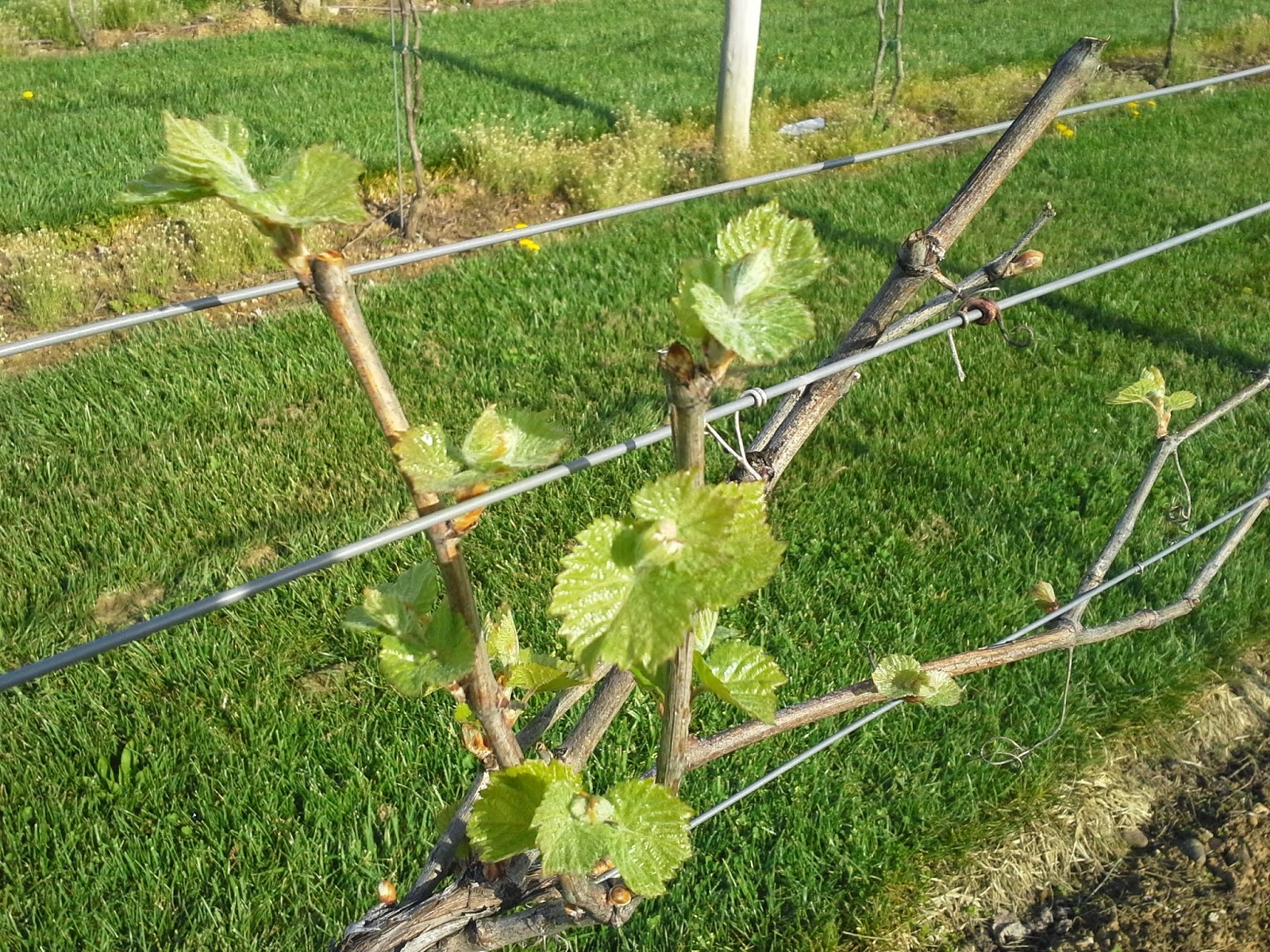
May 9, 2014: First leaf on the Marquette vines, North Vineyard
After months of work amongst dormant grape canes, and then weeks surrounded by fragile swelling buds, we now see the first green grape leaves of the season.

And what a welcome sight.

It's a day we have been anticipating: each day since the soil started warming (ever so slowly this year), we have been scouting our fifty five acres as we pass through them each day, and making note of what is in bloom, as well as which of our resident vineyard birds are hatching.

The goal is establishing a  phenology log, to help us better understand the specific characteristics of the six grape varieties we grow, and to understand the nuance of how they perform in our micro climate.

Among other things, we want to be able to accurately predict the date of bud burst for each variety in our specific vineyard terrain.

And so, here it is: some highlights from the chronicle of what bloomed, and when, here on our historic farm, in this most unusual spring:

March 20: (first day of spring!): First sap flow in the vines.

April 1: Skunk cabbage in the marsh sends up spears


April 1:  First crocuses bloom at the Vineyard Office


April 13: Norway maple seeds sprouting

April 14: Forsythia in bloom     

April 14: Daffodils bloom at the Farmhouse

April 14: Cornelian dogwwood blossoms at the Marketplace

April 14: Periwinkle at the Villas

April 15: Vineyard ducks lay their first eggs
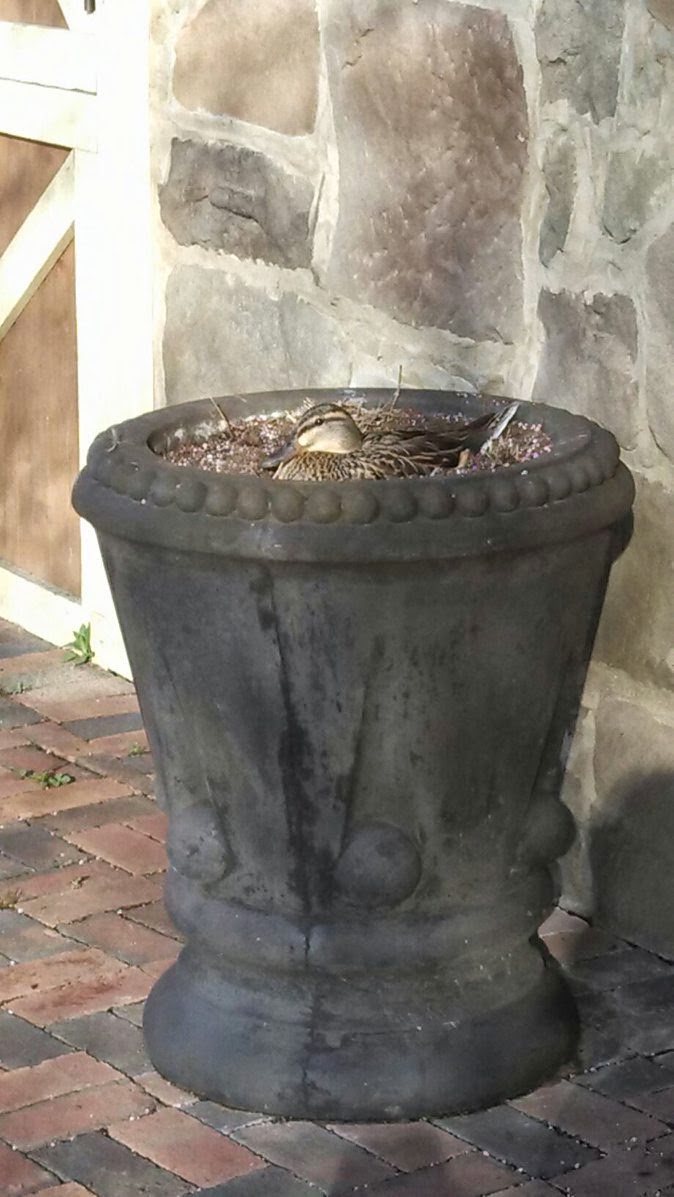
Female mallard tends her eggs in a vineyard flower pot.
April 17: Privet and multiflora rose leaf out in the hedge rows

April 18: Red maple bud burst

April 21: Weeping willow catkins

April 27: Bartlett pear blossoms in orchard 


April 29: First dogwood bracts


April 21: Vineyard killdeer lay eggs in North Vineyard
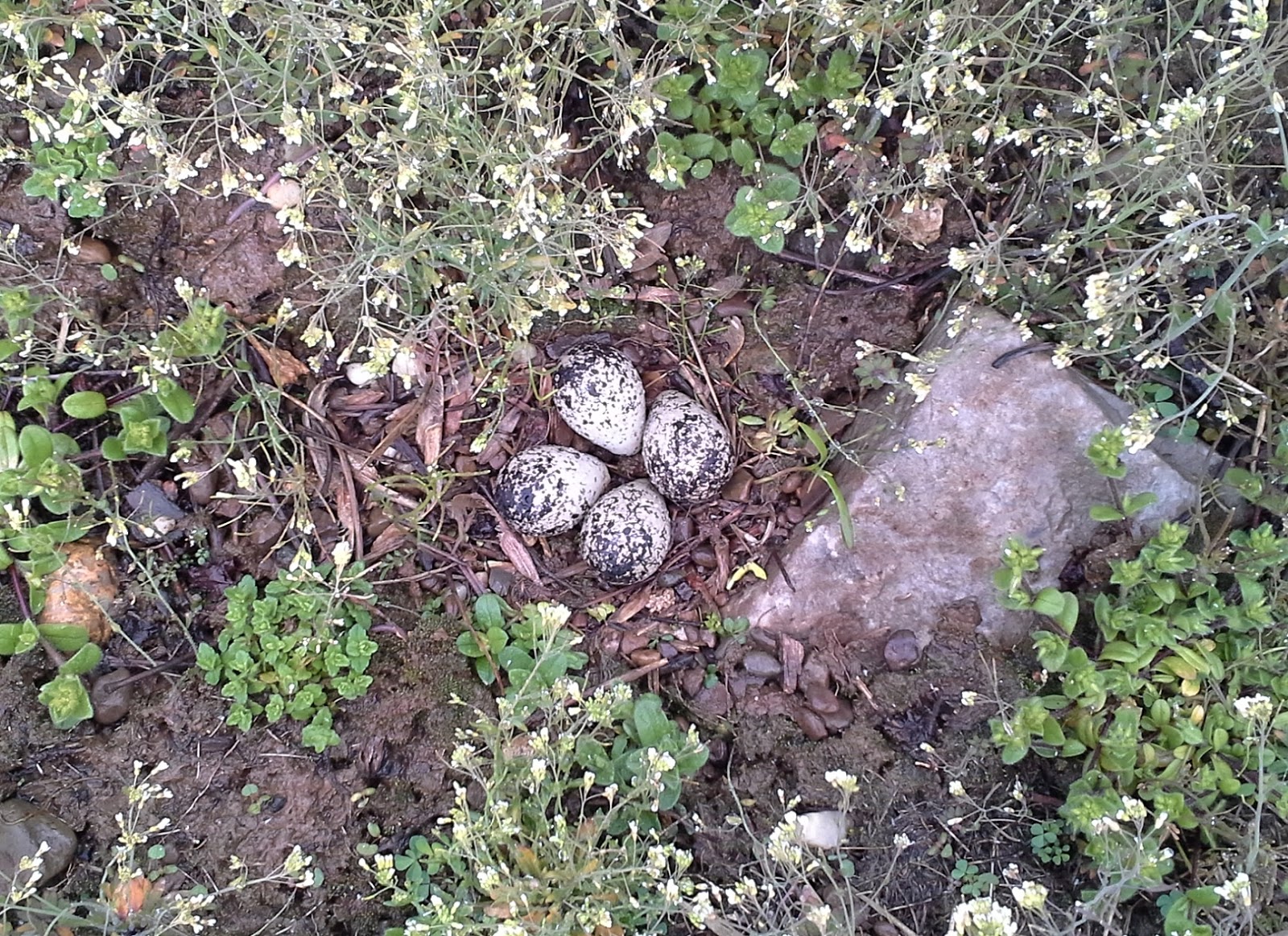

Speckled Killdeer eggs beneath the Frontenac Gris
May 1: Full dandelion bloom

May 2: Tulips at Carriage House

May 6: Red maple leaf out

May 5: Fiddleheads on Farmhouse ferns 


May 6: First apple blossoms

May 6: Dogtooth violets bloom

May 6: Vineyard Killdeer hatch
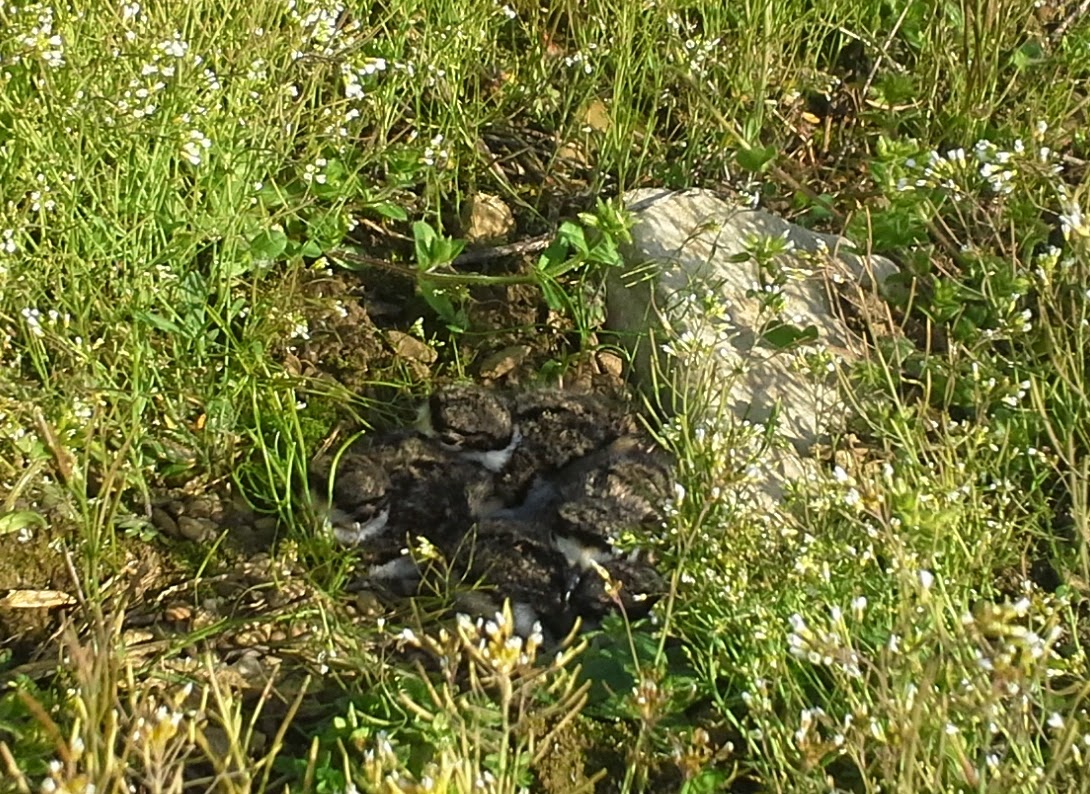

Very well camouflaged Killdeer hatchlings beneath the Frontenac Gris
May 7: Farmhouse lilacs bloom


May 8: Farmhouse crabapples bloom


May 8: Orchard in full bloom and first leaf out

May 9: Vineyard in full bud burst, with earliest varieties in leaf out

And so, we arrive at the culmination, which seems all the more epic after observing and noting each phenological marker as it occurred.

The vineyard bursts into leaf. 

Fifty one days after the vine sap first flowed. 

Thirty nine days after the skunk cabbages unfurled steamily from the swamp. 

Twenty six days after the forsythia blooms. 

Three days after the killdeer hatched.

Which brings us back to Mrs. Reynolds, that wise country schoolteacher, who burst into the classroom each morning with boundless enthusiasm, both for the work before us that day, and what was happening back home at the farm.

It only took me several decades, and almost four years on this farm, to begin to realize the depth of the wisdom she so effortlessly taught us:

Notice the things around you.
Make note of what is blooming each day.
Take care of other living things.
Anticipate what is about to happen.
Appreciate what is occurring right now.

I can't help but think that her infectious energy was absorbed in part from plunging herself so fully into the abundant life of the farm she so loved.

Vineyard phenology wasn't part of the curriculum Mrs. Reynolds was teaching in her Third Grade classroom so long ago. But lo and behold, it was a small part of the life wisdom she so graciously imparted.


Thursday, April 24, 2014

Swell

The flowers are come on the earth; 
the time of cutting the vines is come, 
and the voice of the dove is sounding in our land.
~Song of Songs 2:12


It's a time of pregnant expectation in the vineyard.

A pair of elegant mourning doves has produced the first brood of the vineyard season, and all around us, expectant ducks and robins and killdeer and blue birds flit about building and tending nests.

Amidst the vines, it's positively raucous at sunrise, even on mornings when frost paints the daffodils.

But our vineyard birds aren't the only ones anxious and expectant these long awaited first warm days of the season. Those of us who tend the vines are also carefully monitoring our "babies" (4,178 of them to be exact.)

Since the first vortex we've been carefully monitoring the buds on thousands of individual vines.

Each new plunge of the thermometer sends us crunching through insulating snow to gather representative sample canes from six grape varieties, in eight vineyard blocks, spread across almost six acres.


Our historic farmhouse, April 15, 2014
We bring them into the warmth of our vineyard office, adjoining the circa 1830 farmhouse on our historic farm,  to thaw out. We then patiently slice each compound bud open with a razor blade under a magnifying lens, to examine the primary, secondary and tertiary buds contained within.

One hundred compound buds sampled, from each of the eight vineyard blocks. We do this each time the temperature plunges. (I'm an English major, not a mathematician, so I will let someone else do the math as to how many buds we looked at over the course of this frigid winter.)

So lets just say, ballpark, scads of buds examined.

And we are reasonably confident that our hardiest Minnesota hybrids came through with a 97% bud survival rate. In a winter of dismal vineyard news from across the Midwest, a glimmer of hope from our young vineyard in Canton. (Although anything can yet happen, and any grape farmer would be foolish to predict a crop in our climate until at least June.)

So, we are not out of the woods yet.

A week ago, the morning of the Full Blood Moon, we arrive to find the old farm under yet another blanket of snow. Overnight vineyard temperatures were logged at 19 degrees, at a time when the grape buds had already started to swell.

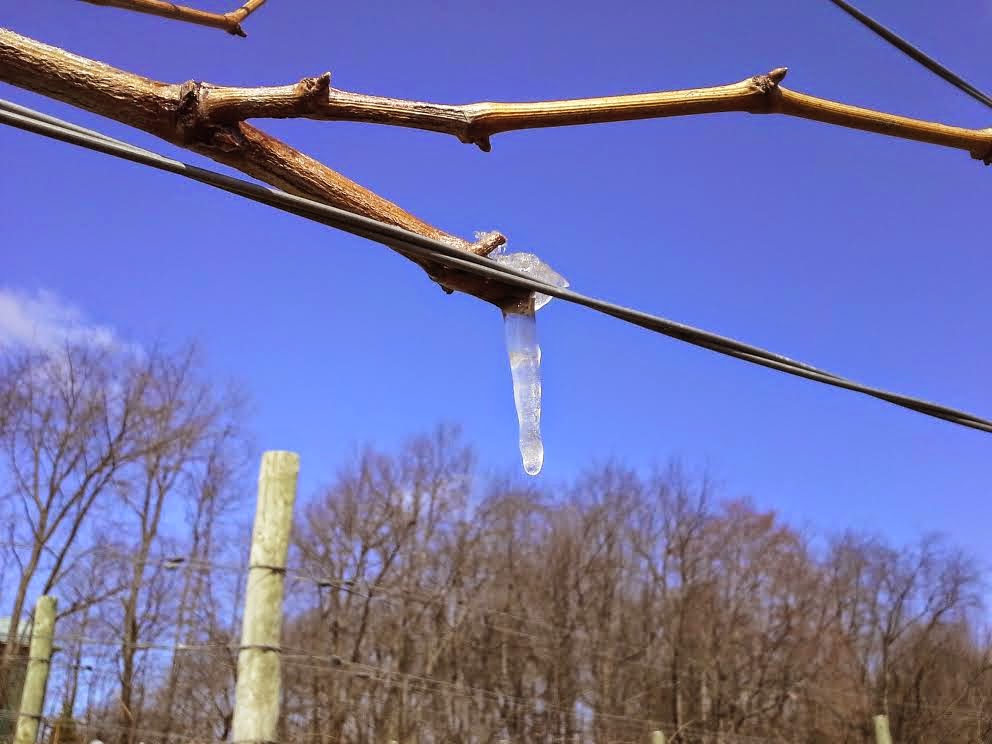
So out we go once more to sample, this time gathering canes from vines dripping with "sap sicles."

"Sap sicle" from a pruning cut in the South Vineyard, April 15, 2015

A week after the blood moon, the buds are still alive, and continuing to swell. Any moment now, we will begin to see the pink and green foliage emerge from the earliest buds to break.

Grape vines exhibit apical dominance, which means the highest buds on each plant break dormancy first, and leaf out before the others.

For this reason, in our micro-climate, which is subject to heartbreaking late spring freezes, we leave longer spurs than are necessary on each plant when we do our winter pruning.

If anxious grape plants decide to break dormancy before winter decides it is ready to release us from its frosty talon, apical dominance ensures that we will have reserve buds lower on the plant to produce a crop.

This strategy of double pruning also means double the pruning labor, but is a necessary provision in our viticultural region.

A carafe of grape canes, forced to break bud.

A few weeks ago, as one dismal report after another rolled in from vineyards throughout the Eastern U.S., I stuck a few pruned grape canes in a wine carafe of water. We'd examined the buds multiple times, tabulating the number of kiwi-green live buds we encountered on each sample cane.

We knew the buds were alive. But still, just to be sure, we couldn't relax until we saw leaves emerge.

And so the other day, that hot house vase of grape canes broke bud.

Pink and green leaflets emerged first.

Then fully fledged leaves.

Now, a few days later, long green shoots, each with several leaves, emerging from the top bud on each cane, as apical dominance decrees.

Any day now, we hope to see the same thing happen on our vineyard vines.

And just like Betty the brown duck, who nests under our hydrangea bushes each year, as soon as our babies hatch, we will puff ourselves up a little bit and show them off.

Betty shows off here on our spring-fed lake, displaying her handsome brood in a neat row on the v-shaped wake she forms through sun-warmed water.

We in the vineyard will show off our equally handsome brood here on the interwebs. Any day now, once the buds break. Stay tuned...

(And we promise, this will be the last of the icy vineyard posts! I think we also said that in February. But this time, we really, really, mean it!)

UPDATE April 28th: 
One of the interesting things about growing grapes, is how localized conditions and micro climates can affect a particular vineyard. Interesting story in our hometown newspaper today about how the same conditions have had different effects at some of our neighboring vineyards:


Thursday, April 10, 2014

Quickening

Suddenly, with a flip of the calendar page, everything has changed amongst the birds.

Winter was a time to hunker down. 


Enormous flocks of Canada geese wintered with us, slumbering en masse at night on the iced lake, by day grubbing voraciously through a mantle of snow to pluck victuals from the turf. In their wake, a cacophony of churned earth and webbed foot prints.

Of a January vineyard morning, I would crunch through diamond-crusted snow before sunrise. 

At sunrise, coming to a small patch of open water, and the flotilla of ice where our swans slumber, I would feel like I'd entered a secret avian dream world: All is peace and crystalline beauty

The swans allowed a small trusted bevy of geese to sleep amongst them on their floating bed chamber, the rest banished to the lakeshore with the ducks. How very wise, I thought, to have these squawky sentries close at hand during the vulnerable silent hours.

During those peaceful winter mornings, I would observe that our ducks never sleep on the ice, except when there is a downy blanket of snow. On a snowy January morning, I arrived at sunrise to find our entire duck colony asleep on snowy ice. They rose with the sun, and begin chattering amongst themselves, waddling busily on the ice. (I think I could be content to watch ducks walk on ice all day.)

But change is afoot in the vineyard, the quickening of the year. 


Maple buds swelling against an April sky.

Skunk cabbage shoots rise steamily from the creekbed. 

Gliding raptors, aloft in a sky that is suddenly cerulean, dangle entrails of branches. 

On a rainy morning I notice our pair of mute swans display a newfound interest in golden willow branches that litter the lawn.

These quickening days, and an ever changing sky:

To the South, golden rays, impossible blue skies, fluffy white clouds.

Northward, impending wintry nebula, dark and foreboding. 

On many days snow flurries mixed with drizzle and warmth. 

This fleeting season, marked by the mysterious arrival of impossibly vivid ducks, with crimson necks. 

Raw, windswept March has just passed, when you would experience all of the seasons in just one day.

But gone now is March, and with it, the mysterious crimson ducks that visit each winter, then disappear as quickly as the whiteout flurries that sometimes materialized to displace a mid-afternoon sun.

The day the crimson ducks departed marked a noticeable change in avian behavior. 

All winter everyone got along, but the day the ducks left, our territorial male swan was suddenly bound and determined to keep a pair of Canada geese from nesting under a cherry tree. I could swear they are the exact same pair that tried to nest here last year, under a pine tree that is now gone. 

As the days lengthen, gone are the large colonies of ducks who gobbled at the swan chow bowl on frigid winter days.

Gone the riotous gaggle of geese who slumbered on the ice by night and rooted riotously through vineyard rows for daytime grub.

Gone the marauding robins who came out of nowhere to strip to bare twigs a crabapple tree which had somehow held its fruit through Christmas.

On these suddenly sunny April days, the birds have all paired off:

The swans daub a nest from mud and leaves and willow branches in a swampy finger of the lake.

An iridescent mallard and his handsome brown speckled bride toddle about the shrubbery at sunrise, looking for a place where in a few weeks she may deposit her eggs.

A pair of elegant mourning doves coo beside an old grape press in the rose bushes, seemingly grateful for the now bare earth on which to roost.

There is something to be said for days spent tending a vineyard. 

Even days that sometimes start with pelting sleet and a glaze of ice. 

And especially days during this magic season, when the year quickens perceptibly, and avian behavior takes a marked seasonal turn. 

An entire complex avian world goes about its seasons on the shore of this lake, and we feel privileged to be here to watch it unfold.

And throughout it all, in every season, a solitary Great Blue Heron swoops overhead, knowingly. (And sometimes, I kind of get the feeling that heron is orchestrating the whole thing.)


Skunk cabbage steamily rises.