Friday, May 9, 2014

Burst!

May 6, 2014: First apple blossoms in the orchard, three days before vineyard bud burst.


I try to keep this blog close to target, talking about grapes and viticulture (with occasional diversions into swan husbandry and the way snow looks in different permutations of winter sky.)

So bear with me a bit today if it seems like I'm rambling...but it all circles back to what is going on in the vineyard right now, the season of the vineyard with the appropriately explosive name: Bud Burst!

One of the wisest women I ever knew, was Mrs. Jane Reynolds.

She was my third grade teacher at Gordon M. DeWitt Elementary School in Cuyahoga Falls, Ohio.

DeWitt School faculty, 1974. Mrs. Reynolds, second from right, front row.
She passed away several weeks ago at the age of 97, after a long and purposeful life.

Although my calculations may be way off (since I was barely four feet tall at the time) I am pretty sure she wasn't much taller than 5'1", and what a dynamo of energy she was.

(Tongues still wag over an mid-1970's last-week-of-school Field Day, where she jumped into the Tug-Of-War, handing decisive victory to her underdog 3-1 grade class, over Mrs. Villemein's much favored 3-2.)

What I remember about her was not just that she was a fantastic teacher, and that she did all the things the other good teachers did, but that she somehow managed to squeeze into each day, and each class, even more than everyone else did.
Above all, I remember her boundless energy.

In addition to her full-time teaching job, she and her husband, Mr. R. O. Reynolds, the retired band director at the high school, had recently moved to and were restoring her ancestral family farm.

(I learned from her obituary that her great-great grandfather had walked from New Hampshire to Ohio to stake a claim on the Western Reserve, and that was the farm she and her husband were restoring.)

Whatever was going on on the farm in a particular season, she would bound into the classroom with examples to show off: The first puffy pussy willow buds of the season. The first drips from the maple buckets during sugaring days. Branches of crabapple in full bloom. The season's first chirpy fluff chicks.

So, for several weeks now, I have been hauling my vase of grape canes around, showing off to anyone who will listen the magic of the buds unfurling, the abundant life inside each inauspicious hard scaly brown bud, which needs just warmth, sunshine and water to unleash abundant green life stored within.

And now that season we had been forcing indoors under hothouse conditions is happening spontaneously in the vineyard acres around us.

May 9, 2014: Ladies and gentlemen, we have achieved BUD BURST.
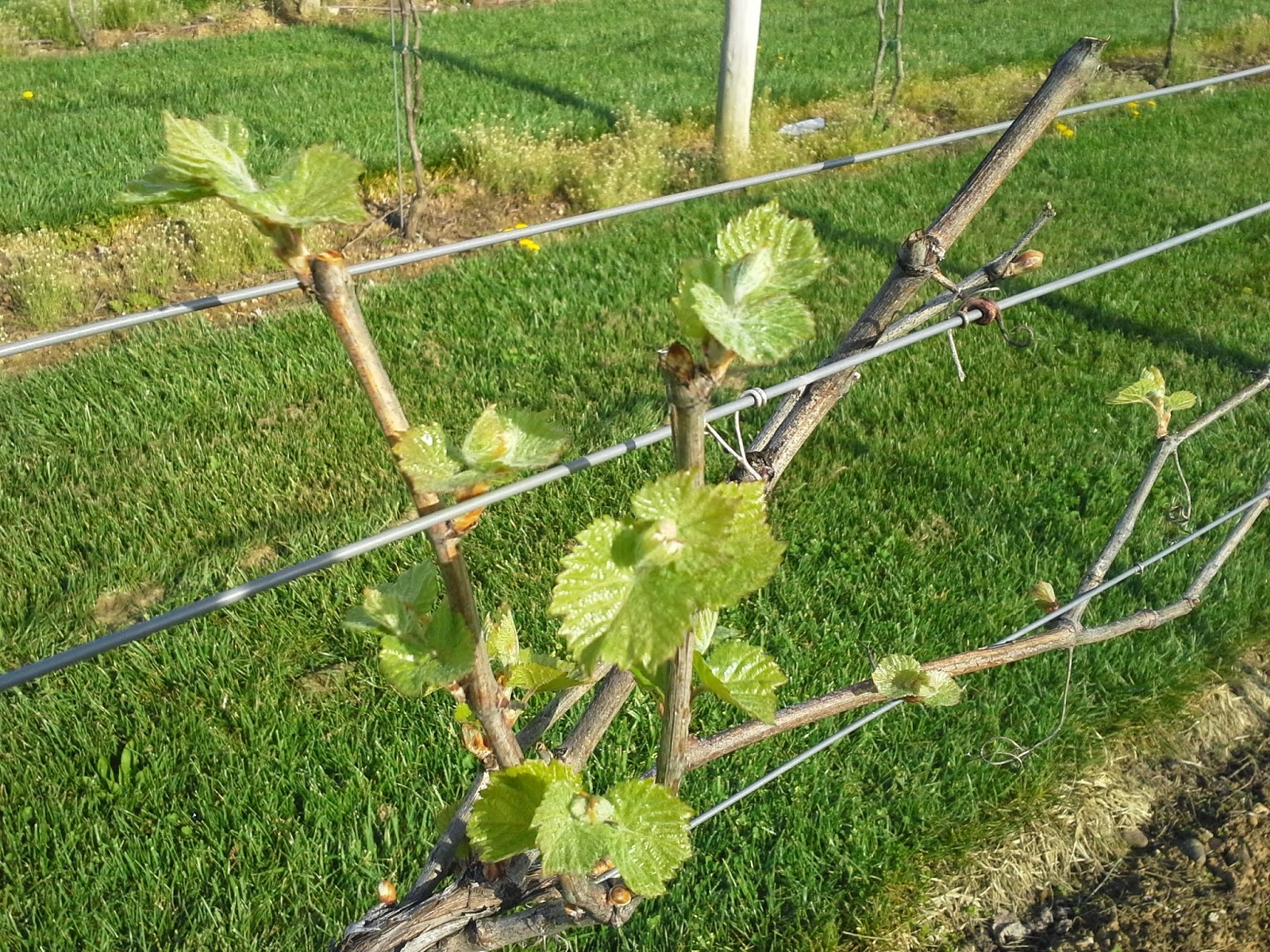
May 9, 2014: First leaf on the Marquette vines, North Vineyard
After months of work amongst dormant grape canes, and then weeks surrounded by fragile swelling buds, we now see the first green grape leaves of the season.

And what a welcome sight.

It's a day we have been anticipating: each day since the soil started warming (ever so slowly this year), we have been scouting our fifty five acres as we pass through them each day, and making note of what is in bloom, as well as which of our resident vineyard birds are hatching.

The goal is establishing a  phenology log, to help us better understand the specific characteristics of the six grape varieties we grow, and to understand the nuance of how they perform in our micro climate.

Among other things, we want to be able to accurately predict the date of bud burst for each variety in our specific vineyard terrain.

And so, here it is: some highlights from the chronicle of what bloomed, and when, here on our historic farm, in this most unusual spring:

March 20: (first day of spring!): First sap flow in the vines.

April 1: Skunk cabbage in the marsh sends up spears


April 1:  First crocuses bloom at the Vineyard Office


April 13: Norway maple seeds sprouting

April 14: Forsythia in bloom     

April 14: Daffodils bloom at the Farmhouse

April 14: Cornelian dogwwood blossoms at the Marketplace

April 14: Periwinkle at the Villas

April 15: Vineyard ducks lay their first eggs
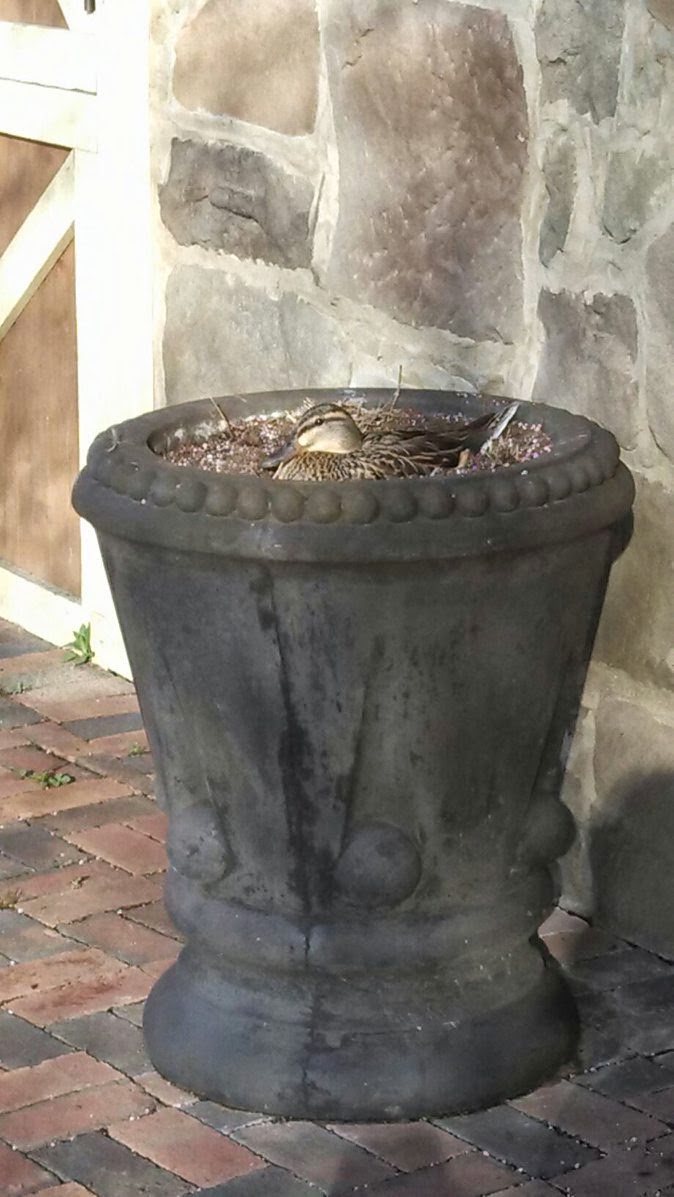
Female mallard tends her eggs in a vineyard flower pot.
April 17: Privet and multiflora rose leaf out in the hedge rows

April 18: Red maple bud burst

April 21: Weeping willow catkins

April 27: Bartlett pear blossoms in orchard 


April 29: First dogwood bracts


April 21: Vineyard killdeer lay eggs in North Vineyard
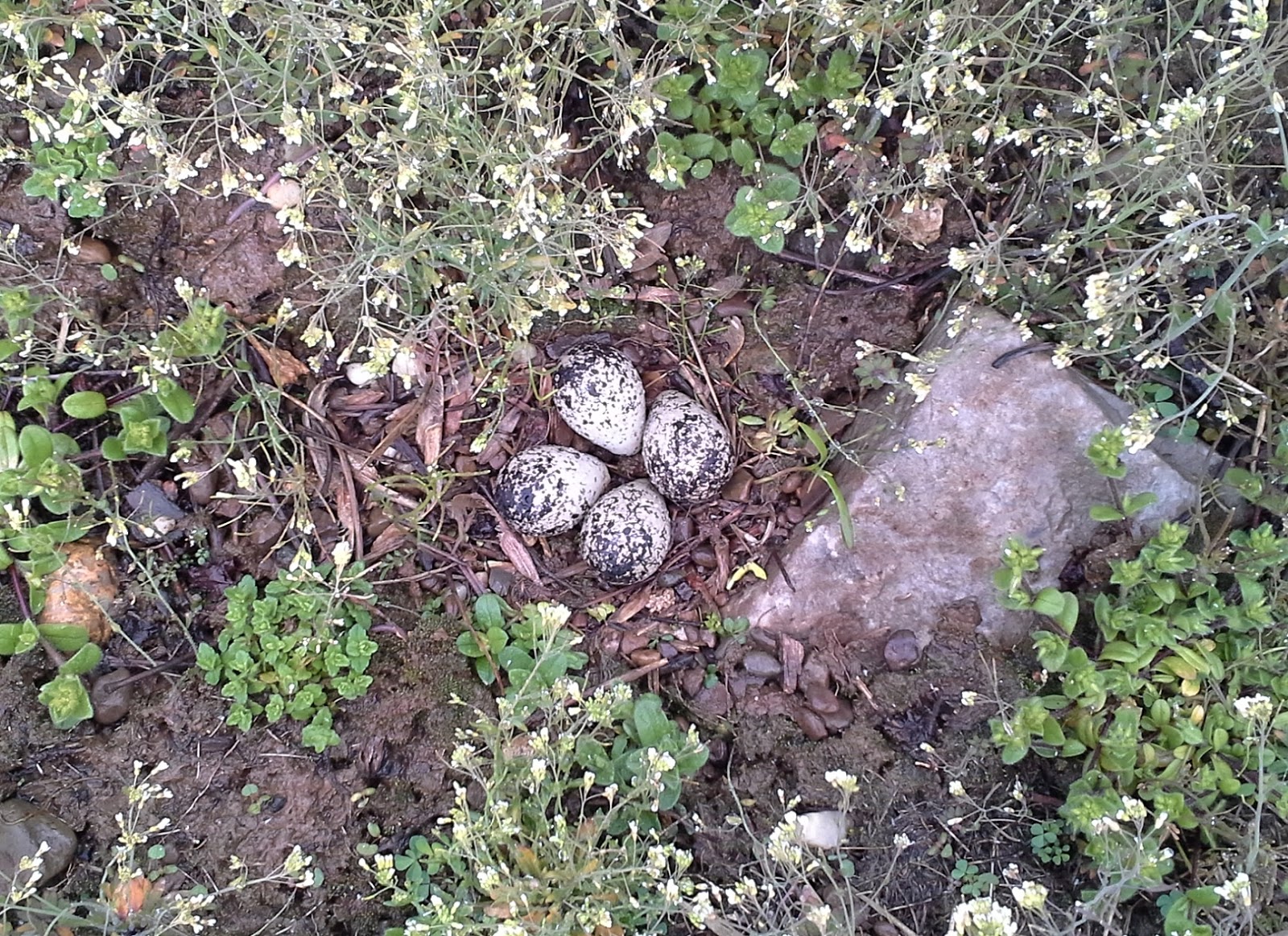

Speckled Killdeer eggs beneath the Frontenac Gris
May 1: Full dandelion bloom

May 2: Tulips at Carriage House

May 6: Red maple leaf out

May 5: Fiddleheads on Farmhouse ferns 


May 6: First apple blossoms

May 6: Dogtooth violets bloom

May 6: Vineyard Killdeer hatch
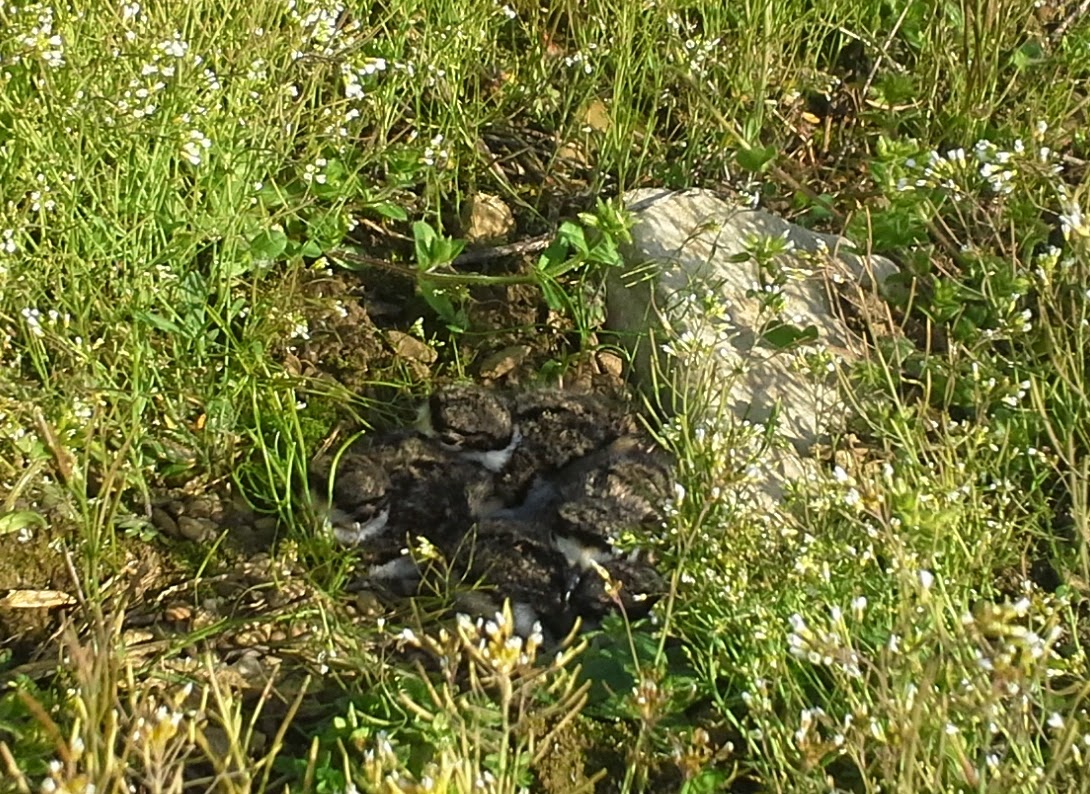

Very well camouflaged Killdeer hatchlings beneath the Frontenac Gris
May 7: Farmhouse lilacs bloom


May 8: Farmhouse crabapples bloom


May 8: Orchard in full bloom and first leaf out

May 9: Vineyard in full bud burst, with earliest varieties in leaf out

And so, we arrive at the culmination, which seems all the more epic after observing and noting each phenological marker as it occurred.

The vineyard bursts into leaf. 

Fifty one days after the vine sap first flowed. 

Thirty nine days after the skunk cabbages unfurled steamily from the swamp. 

Twenty six days after the forsythia blooms. 

Three days after the killdeer hatched.

Which brings us back to Mrs. Reynolds, that wise country schoolteacher, who burst into the classroom each morning with boundless enthusiasm, both for the work before us that day, and what was happening back home at the farm.

It only took me several decades, and almost four years on this farm, to begin to realize the depth of the wisdom she so effortlessly taught us:

Notice the things around you.
Make note of what is blooming each day.
Take care of other living things.
Anticipate what is about to happen.
Appreciate what is occurring right now.

I can't help but think that her infectious energy was absorbed in part from plunging herself so fully into the abundant life of the farm she so loved.

Vineyard phenology wasn't part of the curriculum Mrs. Reynolds was teaching in her Third Grade classroom so long ago. But lo and behold, it was a small part of the life wisdom she so graciously imparted.


Thursday, April 24, 2014

Swell

The flowers are come on the earth; 
the time of cutting the vines is come, 
and the voice of the dove is sounding in our land.
~Song of Songs 2:12


It's a time of pregnant expectation in the vineyard.

A pair of elegant mourning doves has produced the first brood of the vineyard season, and all around us, expectant ducks and robins and killdeer and blue birds flit about building and tending nests.

Amidst the vines, it's positively raucous at sunrise, even on mornings when frost paints the daffodils.

But our vineyard birds aren't the only ones anxious and expectant these long awaited first warm days of the season. Those of us who tend the vines are also carefully monitoring our "babies" (4,178 of them to be exact.)

Since the first vortex we've been carefully monitoring the buds on thousands of individual vines.

Each new plunge of the thermometer sends us crunching through insulating snow to gather representative sample canes from six grape varieties, in eight vineyard blocks, spread across almost six acres.


Our historic farmhouse, April 15, 2014
We bring them into the warmth of our vineyard office, adjoining the circa 1830 farmhouse on our historic farm,  to thaw out. We then patiently slice each compound bud open with a razor blade under a magnifying lens, to examine the primary, secondary and tertiary buds contained within.

One hundred compound buds sampled, from each of the eight vineyard blocks. We do this each time the temperature plunges. (I'm an English major, not a mathematician, so I will let someone else do the math as to how many buds we looked at over the course of this frigid winter.)

So lets just say, ballpark, scads of buds examined.

And we are reasonably confident that our hardiest Minnesota hybrids came through with a 97% bud survival rate. In a winter of dismal vineyard news from across the Midwest, a glimmer of hope from our young vineyard in Canton. (Although anything can yet happen, and any grape farmer would be foolish to predict a crop in our climate until at least June.)

So, we are not out of the woods yet.

A week ago, the morning of the Full Blood Moon, we arrive to find the old farm under yet another blanket of snow. Overnight vineyard temperatures were logged at 19 degrees, at a time when the grape buds had already started to swell.

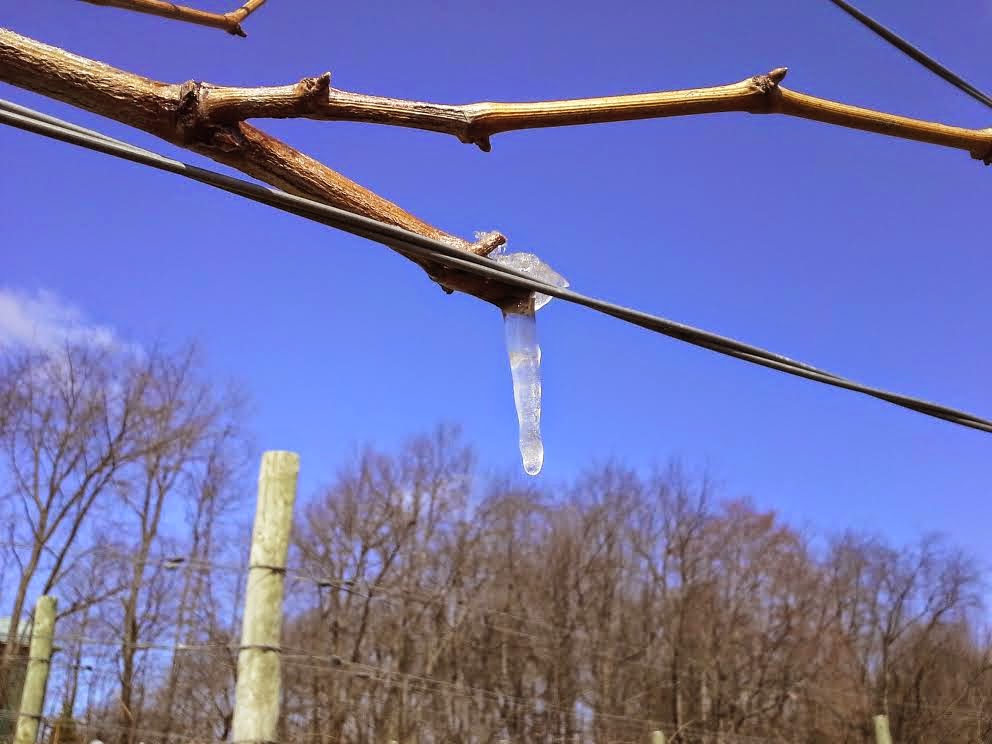
So out we go once more to sample, this time gathering canes from vines dripping with "sap sicles."

"Sap sicle" from a pruning cut in the South Vineyard, April 15, 2015

A week after the blood moon, the buds are still alive, and continuing to swell. Any moment now, we will begin to see the pink and green foliage emerge from the earliest buds to break.

Grape vines exhibit apical dominance, which means the highest buds on each plant break dormancy first, and leaf out before the others.

For this reason, in our micro-climate, which is subject to heartbreaking late spring freezes, we leave longer spurs than are necessary on each plant when we do our winter pruning.

If anxious grape plants decide to break dormancy before winter decides it is ready to release us from its frosty talon, apical dominance ensures that we will have reserve buds lower on the plant to produce a crop.

This strategy of double pruning also means double the pruning labor, but is a necessary provision in our viticultural region.

A carafe of grape canes, forced to break bud.

A few weeks ago, as one dismal report after another rolled in from vineyards throughout the Eastern U.S., I stuck a few pruned grape canes in a wine carafe of water. We'd examined the buds multiple times, tabulating the number of kiwi-green live buds we encountered on each sample cane.

We knew the buds were alive. But still, just to be sure, we couldn't relax until we saw leaves emerge.

And so the other day, that hot house vase of grape canes broke bud.

Pink and green leaflets emerged first.

Then fully fledged leaves.

Now, a few days later, long green shoots, each with several leaves, emerging from the top bud on each cane, as apical dominance decrees.

Any day now, we hope to see the same thing happen on our vineyard vines.

And just like Betty the brown duck, who nests under our hydrangea bushes each year, as soon as our babies hatch, we will puff ourselves up a little bit and show them off.

Betty shows off here on our spring-fed lake, displaying her handsome brood in a neat row on the v-shaped wake she forms through sun-warmed water.

We in the vineyard will show off our equally handsome brood here on the interwebs. Any day now, once the buds break. Stay tuned...

(And we promise, this will be the last of the icy vineyard posts! I think we also said that in February. But this time, we really, really, mean it!)

UPDATE April 28th: 
One of the interesting things about growing grapes, is how localized conditions and micro climates can affect a particular vineyard. Interesting story in our hometown newspaper today about how the same conditions have had different effects at some of our neighboring vineyards:


Thursday, April 10, 2014

Quickening

Suddenly, with a flip of the calendar page, everything has changed amongst the birds.

Winter was a time to hunker down. 


Enormous flocks of Canada geese wintered with us, slumbering en masse at night on the iced lake, by day grubbing voraciously through a mantle of snow to pluck victuals from the turf. In their wake, a cacophony of churned earth and webbed foot prints.

Of a January vineyard morning, I would crunch through diamond-crusted snow before sunrise. 

At sunrise, coming to a small patch of open water, and the flotilla of ice where our swans slumber, I would feel like I'd entered a secret avian dream world: All is peace and crystalline beauty

The swans allowed a small trusted bevy of geese to sleep amongst them on their floating bed chamber, the rest banished to the lakeshore with the ducks. How very wise, I thought, to have these squawky sentries close at hand during the vulnerable silent hours.

During those peaceful winter mornings, I would observe that our ducks never sleep on the ice, except when there is a downy blanket of snow. On a snowy January morning, I arrived at sunrise to find our entire duck colony asleep on snowy ice. They rose with the sun, and begin chattering amongst themselves, waddling busily on the ice. (I think I could be content to watch ducks walk on ice all day.)

But change is afoot in the vineyard, the quickening of the year. 


Maple buds swelling against an April sky.

Skunk cabbage shoots rise steamily from the creekbed. 

Gliding raptors, aloft in a sky that is suddenly cerulean, dangle entrails of branches. 

On a rainy morning I notice our pair of mute swans display a newfound interest in golden willow branches that litter the lawn.

These quickening days, and an ever changing sky:

To the South, golden rays, impossible blue skies, fluffy white clouds.

Northward, impending wintry nebula, dark and foreboding. 

On many days snow flurries mixed with drizzle and warmth. 

This fleeting season, marked by the mysterious arrival of impossibly vivid ducks, with crimson necks. 

Raw, windswept March has just passed, when you would experience all of the seasons in just one day.

But gone now is March, and with it, the mysterious crimson ducks that visit each winter, then disappear as quickly as the whiteout flurries that sometimes materialized to displace a mid-afternoon sun.

The day the crimson ducks departed marked a noticeable change in avian behavior. 

All winter everyone got along, but the day the ducks left, our territorial male swan was suddenly bound and determined to keep a pair of Canada geese from nesting under a cherry tree. I could swear they are the exact same pair that tried to nest here last year, under a pine tree that is now gone. 

As the days lengthen, gone are the large colonies of ducks who gobbled at the swan chow bowl on frigid winter days.

Gone the riotous gaggle of geese who slumbered on the ice by night and rooted riotously through vineyard rows for daytime grub.

Gone the marauding robins who came out of nowhere to strip to bare twigs a crabapple tree which had somehow held its fruit through Christmas.

On these suddenly sunny April days, the birds have all paired off:

The swans daub a nest from mud and leaves and willow branches in a swampy finger of the lake.

An iridescent mallard and his handsome brown speckled bride toddle about the shrubbery at sunrise, looking for a place where in a few weeks she may deposit her eggs.

A pair of elegant mourning doves coo beside an old grape press in the rose bushes, seemingly grateful for the now bare earth on which to roost.

There is something to be said for days spent tending a vineyard. 

Even days that sometimes start with pelting sleet and a glaze of ice. 

And especially days during this magic season, when the year quickens perceptibly, and avian behavior takes a marked seasonal turn. 

An entire complex avian world goes about its seasons on the shore of this lake, and we feel privileged to be here to watch it unfold.

And throughout it all, in every season, a solitary Great Blue Heron swoops overhead, knowingly. (And sometimes, I kind of get the feeling that heron is orchestrating the whole thing.)


Skunk cabbage steamily rises.

Thursday, March 20, 2014

Persephone

The ancients had a goddess for this day: Persephone.

Whisked away to the underworld after the harvest, Persephone was said to take with her all that was green and vital, leaving mortals behind to languish in a barren realm. 

And then, this joyous day, the vernal equinox. From a cleft in the earth, Persephone was said to return, and once more, the world would be awash in color and rampant with new growth.

Today, the first day of spring, found us out in the vineyard, continuing the work we began many cold months ago: pruning back last season's grape canes, leaving behind just those few choice buds we select to bear this season's fruit.

Was the vineyard suddenly different today? Were we awash in color? Did the earth's mantle cleave and release a new birth of life?

Well, all things are relative.

This first day of spring in Canton, Ohio, the sky was leaden.

Snow flurries fell.

A raw wind blew.

Although the blanket of white we tromped through for most of our winter was largely gone, it was not replaced by a verdant carpet, but rather by mud and a thatch of brown turf.

As we finished up the Marquette block and made steady progress through the Frontenac Gris, the rhythm of stainless steel blades snapping through last summer's now dormant growth competed with raucous avian rivalries from a rapidly thawing lake.

Each pruning cut revealed the familiar kiwi green that has fed our winter weary souls through a long frigid season: the response of our resilient grape vines to a season of brutal cold. Encased in dull brown cells of insulating tissue, the vital force of each plant remained visible, even in the dim light of a sun shrouded by flurries. 

And yet, today, something WAS different:

Pruning cut, March 20, 2014
At a certain point in the afternoon, as the sun burned through gray, the brown turf warmed just a few more degrees. 

Not enough warmth to feel a discernible difference on wind chaffed skin, but enough to trigger the movement of vital fluids from grape roots drenched within a thawing terrain. 

Up through craggy six-year old trunks, through cordons stretched horizontally across galvanized trellis wire, and eventually, out, out into the sunshine, the vital fluids of each plant flowed.

The difference we experienced today: those kiwi green pruning cuts glistened.

Sap is rising. The grape vines bled, which is a good and beautiful thing.

Nutrients and vitality pulsed from the ground below, priming each vine's vascular system, cleansing each pruning wound.

As our clay soil thaws and spring rains fall, our terrain will likely persist for some time in its sodden state. (Which is hardly surprising in our region of the world, where a massive clay bed fed the nation's leading paving brick industry, centered right here in Canton, Ohio.)

Canton paving bricks in autumn, a legacy of our terrain.
Days will arrive (soon, we hope) when bright sun will shine, and the temperature will rise above fifty.

On those days, our pruning cuts will gush, and we will delight, sure of Persephone's return.

Perhaps the earth did not cleave in our vineyard soil today.

But nonetheless, something new and vital rose from the earth below.

Perhaps it was not as dramatic as classical depictions of Persephone's return from exile in the underworld.

But for those of us who toil  routinely through seemingly changeless seasons, our reward is being present for subtle shifts in the status quo.

Today's pruning cuts were no different from thousands we made all winter.

Except that they WERE. 

They glowed, saturated with nectar arising from a wakening earth.

Frederic Leighton's Return of Persephone (1821)


Thursday, March 6, 2014

Red

Our 1952 Farmall Tractor rests at the edge of our north vineyard. A mantle of sparkling snow still lingers upon it. In the frigid March sun, its red steel glows preternaturally bright.


With apologies to the poet William Carlos Williams, who wrote so memorably so many decades ago about a now-famous red wagon glazed in rain,

so much depends
upon
a red tractor
glazed with ice
crystals
beside the white
swans.

This remarkably bright March morning, which is also remarkably cold, our snowy tractor seems to epitomize where we are in this most unusual winter season.

Normally all the apple trees in the orchard would have been pruned months ago. 


In the vineyard, we would be going through and doing a second round of pruning, to adjust the number of buds. We would begin to see the buds swell, the fuzzy down under the shiny red outer scales starting to emerge.

Of course, there is no such thing as a “normal” winter. If we harken back two Marches ago, we were sweltering in an unprecedented string of 80 degree days.

But this winter, time seems to stand still. 

It is no warmer in March than it had been in January.

The grass is still mostly crusted in snow.

The snow around Bucky the vineyard groundhog’s winter den remains untrodden.

The vineyard is still mostly unpruned, as we monitor the effects of temperatures not recorded in decades, in this the winter of the  vortex, the winter of Janus.

The vineyard sleeps.

The tractor rests.

Its red paint glows in cold but bright sun.

But on schedule, the red headed ducks that appear every February returned to Lake Gervasi a few weeks ago. They have joined our iridescent mallards, and our patient, regal swans, who circle a small patch of open water waiting for the day they may begin gathering willow branches for their yet-to-be-built nest.

The predicted arrival of the migrating ducks with the startling gray backs and crimson heads lets us know that although we are poised in a lingering chill, the days are lengthening.

The sun, though cold, is bright.

Grape vine pruning will proceed double time as soon as conditions allow. In the meantime, we cut open shiny red grape bud scales, to see if the tissue inside is vivid green, and therefore, alive. (So far, our very cold hardy Minnesota and Cornell-bred vines are holding up well.)

Perhaps I will leave our vineyard swans some grape canes, to augment the willow boughs in the construction of their still un-built nest. Red canes entwined with golden willow branches seem fitting, somehow, for a late-breaking spring.


Friday, February 14, 2014

Romance


Although an ancient and widely celebrated holiday, the origins of St. Valentine’s Day as a celebration of romance remain strangely murky.

And yet, going back to some of Europe’s oldest folklore, this has always been a day associated with, perhaps surprisingly, birds.

In Geoffrey Chaucer’s ‘The Parliament of Fowls’ (circa 1381), birds gather at the bower of “the noble goddess Nature” to settle love rivalries:

For this was on saint Valentinës day
When every fowl cometh there to chose his mate.

And so it went, through the centuries, February 14th was deemed the day the birds select their mates. (Which may work well in more temperate Europe, but particularly in a winter such as this, mid February is rarely the finest day to go a-courtin’ in our climate.)

Perhaps because vineyard work is largely solitary work (and grapevines are not particularly chatty) those of us who tend the vines often feel an affinity with the critters who share the landscape with us, and Gervasi Vineyard's diverse fifty-five acres of vineyard, woodland, fallow pasture, and wetlands support a particularly lively community of birds.


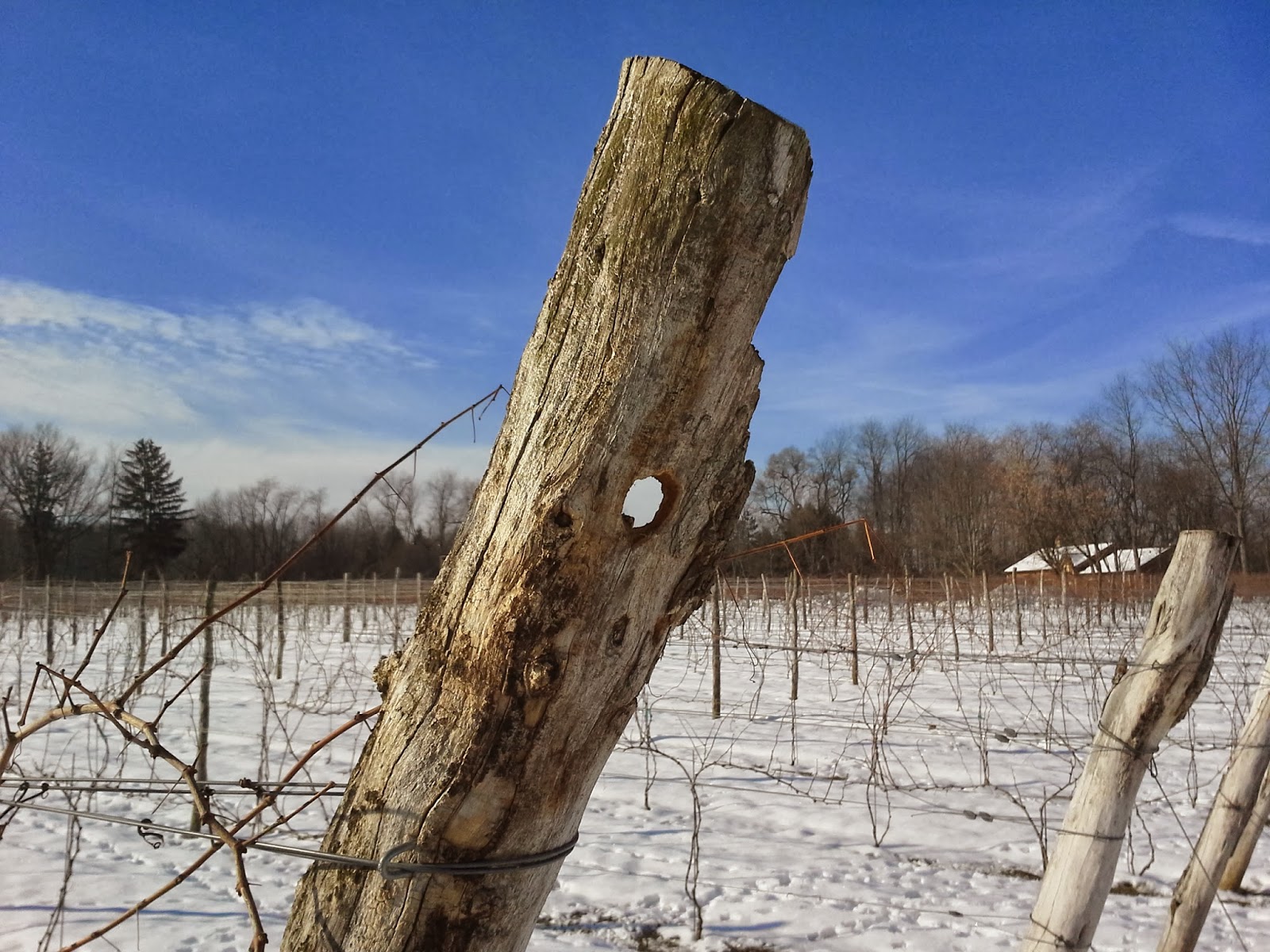
Knotty locust vineyard poles.
  • Barn swallows and bluebirds nest in the holes in our natural locust trellis poles, helping to control the insect population and keeping our grapevines healthy.
  • Chirpy killdeer build pebble nests on the open soil below the vines, depositing speckled eggs perfectly camouflaged amongst smooth glacial stones.
  • Eagles and hawks swoop majestically above our old crop fields, while sharp-kneed Great Blue Heron fish patiently in deep pools along the meandering creek that transects this, the last working farm in Canton, Ohio.
Among all of these creatures, however, it is clear that one pair rules the roost: Gina and Giuseppe, our regal pair of white mute swans.


During winter months you might find them bedded down on snow nests they build on ice patches on the lake.

If we ever get some warm days this winter, you will find Giuseppe diving down to the deepest muck of the lake, to begin daubing a leaf, mud, and willow branch throne for his lovely bride, Gina.

It is during the summer months, however, that Gina and Giuseppe are in their element. On certain crystalline Tuscan afternoons, when the afternoon light is perfect, Gina and Giuseppe glide in to view. They pirouette, dive and splash extravagantly, and, on occasion, touch bills, elegant necks joined together as a heart, perfectly reflected in still blue water.

Being mute swans, of course they cannot speak, but we like to think this is their way of saying Benvenuto!

Because mute swans mate for life, Giuseppe does not need to enact the ancient folkloric ritual of choosing a new mate each February 14th.


But if you are strolling our grounds this snowy Valentine’s Day, or any day of the year, and you happen to encounter our regal pair touching bills to form a heart with their elegant necks, consider it your personal welcome to Gervasi Vineyard, and the romanza of this place.

Monday, February 3, 2014

Shadows

February 2nd has come and gone, which means the sun has just passed the halfway mark on in its journey from the winter solstice to the spring equinox.

The days grow perceptibly longer.

Which also means North America's largest rodent has just had his day in the sun (or shadows, as the case may be).

Marmota monax, the common North American woodchuck.
The famous Pennsylvania rodent has been roused by a gentleman in a top hat from his rather well-appointed den.

Here at the vineyard, Bucky, our resident Marmota monax has yet to stir.

His rocky den, on a sunny vineyard slope under a Petite Pearl grape vine, is still blanketed under an undisturbed snow:


Of course, this may or may not be the den where he is sleeping, as groundhogs are known to construct multiple chambers, the winter quarters often more secluded than the summer lodgings.

But this is where he was last seen, on one of those golden autumn afternoons, when the sweet gum trees blazed orange along the creek bed, and the enormous cottonwood by the bridge glowed amber.

Given that we are coming off one of the coldest Januaries in memory, and the East Coast is forecast to be blasted again this week, our resident rodent's extended slumber is not unexpected, nor does his Pennsylvania cousin's notoriously inaccurate prediction of an extended winter seem far off this time around.

As we trudge through the frozen vineyard rows doing winter pruning, we perhaps feel a kinship with those agrarian immigrants from long ago, who brought from Europe their ancient seasonal folklore, substituting our portly North American woodchuck for the black and white striped badger who was the European prognosticator of Spring.

This midpoint of winter, we are desperate for any sign of reassurance, so it is natural to look toward our familiar vineyard denizens for impending change.

Our sharp-kneed Blue Heron, who lives in the reeds, has been a bit more visible of late, swooping majestically over the lake, on warm days when the sun opens up some water.

Footprints reveal Mr. Muskrat has made a few furtive forays from his willow tree den, not making it far before circling back home.

I will continue to be on the lookout for Bucky, our somewhat reticent vineyard woodchuck, who in the summer perches on his stubby hind legs as a silent sentinel in the South Vineyard, until he sees me and lumbers back to his rocky warren at a surprisingly fast clip, for a gentleman of such ample proportion.

Until Bucky rouses himself, it is to our swans I will look as true harbingers of spring.


These days at sunrise I arrive to find Gina and Giuseppe hunkered down on snow nests atop an icy lake.

But some day soon, around the time newly amorous skunks perfume the sunrise, I will arrive to find Gina and Giuseppe swimming along the shore, with a new found interest in twigs and branches.

A flurry of activity will ensue, and once Gina is enshrined atop her floating twiggy throne, we will know it won't be long until the vineyard buds break.

Until then, Bucky continues to slumber.

Sleeping off, I imagine, a late autumn indulgence of overripe grapes.